
Masterbatches for Injection-Moulded PP Luggage Bags: Engineering Toughness, Surface Quality and Processing Consistency
Introduction
Polypropylene luggage must combine low weight, impact performance, dimensional accuracy and an attractive surface. A suitcase shell experiences repeated handling, compression, abrasion and localised loading around its wheels, handles and closure system. Its formulation must therefore support both mechanical performance and consistent moulding.
Bajaj Masterbatch offers colour, white, black and functional additive families that can be evaluated for PP luggage applications. Selecting the appropriate masterbatch involves matching the carrier, active ingredients and dosage to the PP resin, shell geometry and finished-product specification.

1. Start with the Material and Performance Requirements
PP is a low-density thermoplastic that can be injection moulded into shaped luggage shells. Impact copolymer grades offer a useful starting point when the design requires a balance of stiffness and toughness, including performance at lower temperatures.
Resin selection should consider melt flow rate (MFR), flexural modulus, impact strength and the intended shell thickness. MFR alone does not establish luggage suitability: a resin that fills the mould readily must also deliver the required mechanical properties in the finished shell.
For formulation development, the base resin, masterbatch package and shell design should be assessed together.

2. Key Technical Features of Injection-Moulded PP Luggage Bags
| Key feature | Technical significance |
|---|---|
| Low shell weight | PP's low density supports lightweight luggage, subject to wall thickness and formulation density. |
| Impact-capable construction | An appropriate PP grade and shell design help the product withstand handling loads. |
| Moulded structural details | Ribs, contours and attachment features can be incorporated into the shell tooling where the design permits. |
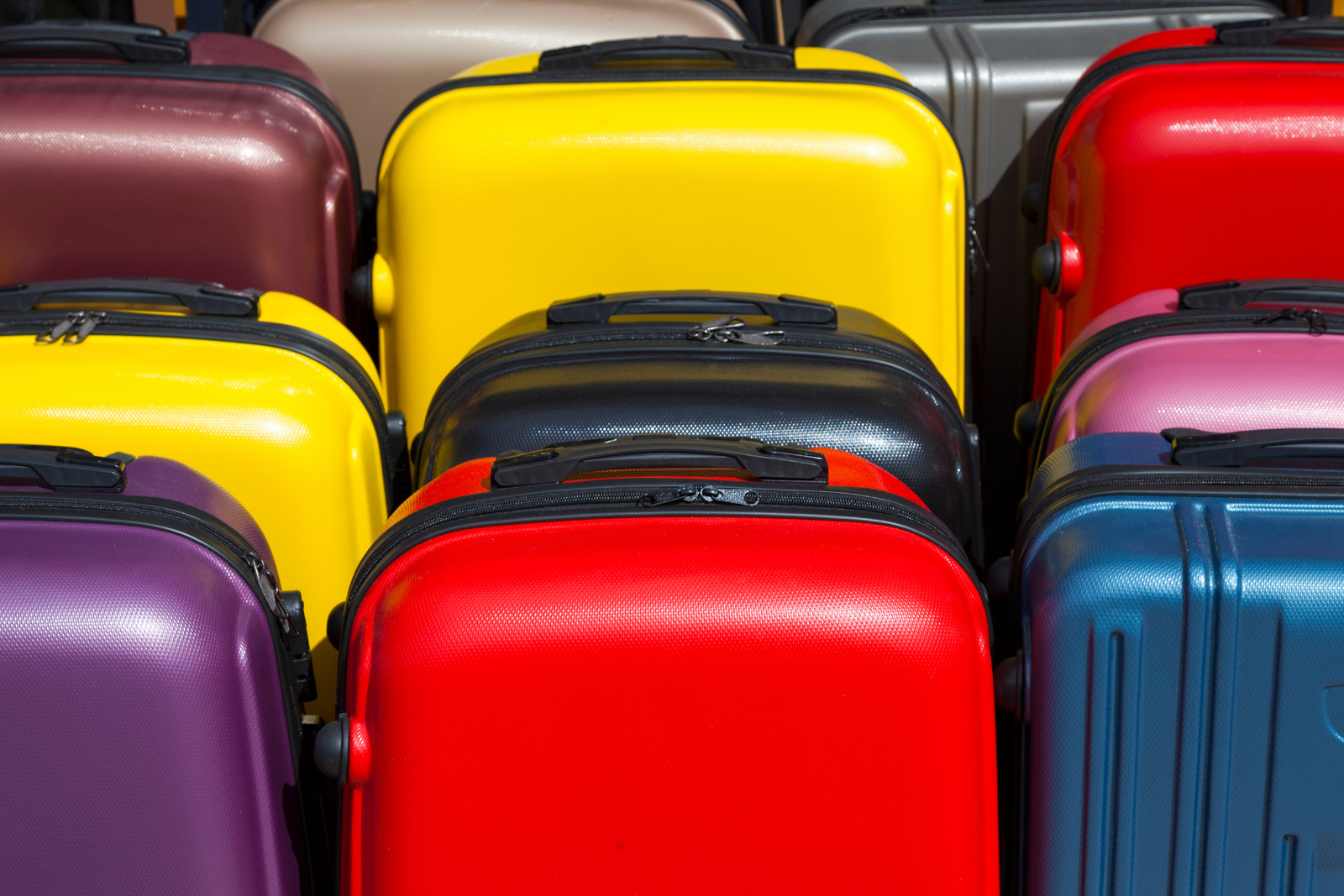
| Customised appearance | Colour masterbatches enable shade development; mould texture and formulation influence the final finish. |
| Adjustable surface performance | Selected additives can improve resistance to visible scuffing, static dust attraction or weathering. |
| Repeatable shell geometry | A controlled moulding process supports consistent fit between shell halves and assembled components. |
3. Key Benefits for Luggage Manufacturers and Brands
- Consistent product identity: Controlled pigmentation supports shade matching across shell halves and production batches.
- Appearance retention: Suitable anti-scratch and stabilisation packages can help preserve surface quality during handling and use.
- Balanced mechanical performance: Application-specific formulation allows stiffness, toughness and weight to be assessed against the luggage specification.
- More reliable assembly: Dimensional consistency supports alignment of closure systems, handles and wheel mountings.
- Production efficiency: Repeatable dosing and validated moulding conditions help maintain an approved process window.
These benefits depend on the complete formulation and manufacturing process; each should be demonstrated through production trials.
4. Understand the Injection Moulding Process for PP Luggage Bags
1. Resin Selection and Masterbatch Dosing
Select the PP resin and masterbatch package against the shell specification. Meter each component accurately and control any approved regrind content.
2. Material Conditioning
Clean PP normally needs no predrying. Check for surface moisture, contaminated regrind and moisture-bearing additives; condition materials according to supplier instructions.
3. Plasticisation and Melt Mixing
Barrel heating and screw rotation melt the blend. Establish uniform dispersion while controlling melt temperature, shear and residence time.
4. Injection and Cavity Filling
Inject the melt into the closed mould. Coordinate fill speed, gate layout and venting to manage flow fronts and weld-line locations.
5. Packing and Holding
Apply holding pressure until gate freeze to compensate for shrinkage. Excessive packing can introduce stress; insufficient packing can produce sinks or voids.
6. Cooling and Ejection
Balance cooling across the shell and eject after sufficient solidification. Check dimensions after conditioning because PP continues to shrink after moulding.
7. Finishing and Assembly
Remove gate remnants and complete any required secondary operations. Assemble the shells with their lining, closures, handles, wheels and locks, then inspect the finished luggage.
Set temperatures, pressures and cycle time for the actual resin and tool. A universal machine recipe cannot cover every shell design.

5. Select Bajaj Masterbatches According to the Required Function
The following product families are candidates for formulation trials. Selection begins with the colour requirement and the stabilisation already present in the base resin. Additional functionality should address a defined performance target.
Carrier selection matters: A masterbatch suitable for use in PP is not necessarily manufactured with a PP carrier. Confirm the carrier polymer, active content, processing stability and recommended let-down ratio in the selected grade's technical data sheet.
1. Bajaj Colour Masterbatches
Colour masterbatches provide the required luggage shade through concentrated pigments dispersed in a carrier resin. Evaluate heat stability, pigment dispersion and colour consistency in the actual PP formulation.
Key benefit: Consistent colour across moulded shells and compatible PP accessories.
Approve the shade on the intended shell texture and thickness, since these influence perceived colour and gloss.
2. Bajaj White Masterbatches
TiO₂ white masterbatches provide whiteness and opacity for white shells or selected pastel formulations. Pigment dispersion and concentration affect hiding power and shade development.
Key benefit: A more uniform white appearance and controlled opacity.
Bajaj's published white range includes PE-carrier injection-moulding grades. Confirm suitability in the chosen PP formulation; obtain a specifically confirmed grade where a PP carrier is required.
3. Bajaj Black Masterbatches
Carbon-black concentrates provide black colour for shells and suitable PP components. Grade selection should consider jetness, undertone, dispersion and the required surface finish.
Key benefit: Consistent black appearance across production runs.
Carbon black can contribute to UV protection, but its effectiveness depends on grade, dispersion and final concentration. Black colour alone does not establish weathering performance.
4. Bajaj Plast Anti-Scratch Masterbatch
Plast Anti-Scratch is relevant where luggage shells require improved resistance to visible scratching and scuffing. Bajaj identifies PP and luggage among the applications for this product family.
Key benefit: Better retention of surface appearance during handling.
Evaluate scratch visibility on the actual colour and texture. Also check compatibility with printing, labels or other surface decoration used in the luggage design.
5. Bajaj Plast UV Masterbatch for Polypropylene
UV stabilisation helps limit photo-oxidative damage to PP exposed to light. The formulation should account for shell thickness, pigmentation and the expected exposure conditions.
Key benefit: Improved retention of appearance and mechanical properties under validated weathering conditions.
Select the stabiliser package alongside the colour formulation. Establish performance through weathering evaluation instead of assigning a fixed outdoor lifetime to every grade.
6. Bajaj Plast Antioxidant Masterbatch
Antioxidant masterbatch supports resistance to oxidative degradation during melt processing and subsequent use. Additional stabilisation deserves evaluation when the formulation includes material with a previous processing history.
Key benefit: Better retention of material properties through the approved production process.
Account for stabilisers already present in the resin. Antioxidants protect against further oxidation; they do not restore polymer chains that have already degraded.
7. Bajaj Plast Modifier PP
Plast Modifier PP includes formulations combining minerals, elastomers and additives. A luggage-specific selection may be evaluated where the stiffness–toughness balance requires adjustment.
Key benefit: An additional route for tuning mechanical behaviour to the component requirement.
Assess shell weight, flexural behaviour, weld-line strength and impact performance at the specified temperatures. Confirm the exact formulation because the family should not be treated as a single universal impact modifier.
8. Bajaj Nucleating Agent Masterbatch
Nucleating agents influence PP crystallisation and can support changes in stiffness, solidification behaviour and dimensional consistency.
Key benefit: Potential improvements in moulding productivity and shell rigidity after process optimisation.
Confirm whether the base resin is already nucleated. Evaluate the effect on shrinkage, shell fit and impact performance before reducing cooling time. For opaque luggage, crystallisation control is more relevant than optical clarification.
9. Bajaj Plast Antistatic Masterbatch
Antistatic masterbatch can reduce electrostatic charge accumulation and associated dust attraction on PP surfaces.
Key benefit: A cleaner-looking surface during storage, display and handling.
Migratory systems depend on additive movement and ambient humidity. Validate performance after ageing and cleaning, and assess interactions with surface decoration and other additives.
10. Bajaj Plast Optical Brightener Masterbatch
Optical brighteners modify perceived whiteness through fluorescence and can help balance a yellowish appearance in suitable white or pale formulations.
Key benefit: Improved visual brightness where required by the colour specification.
An optical brightener does not replace TiO₂ for opacity or restore degraded material properties. Assess colour under the agreed lighting conditions and in combination with the UV stabilisation package.
11. Bajaj PP Base Filler Masterbatch
This family disperses calcium carbonate in a PP carrier and may be evaluated for selected components where stiffness and formulation economics are priorities.
Key benefit: A means of adjusting mineral content and material cost within an approved formulation.
Mineral addition increases formulation density and can alter impact behaviour. For luggage shells, compare cost per acceptable component, finished weight and drop performance before approving the loading.
12. Bajaj Plast Desiccant Masterbatch
Desiccant masterbatch is a conditional option when moisture enters through recycled feedstock, fillers or other ingredients and contributes to processing defects.
Key benefit: Reduction of moisture-related defects where trials confirm the cause and solution.
Bajaj's published page identifies a PE-based desiccant grade. Confirm PP compatibility or request a suitable alternative. Use it for a diagnosed moisture problem, alongside proper material handling.

6. Match Grade Selection and Dosage to the Complete Formulation
Masterbatch selection should consider the entire blend, including the base resin's existing stabilisation, pigmentation and any approved recycled content. Adding several functional masterbatches can change the total carrier and additive loading.
For a technical evaluation, establish the following:
| Selection parameter | Question to resolve |
|---|---|
| Carrier compatibility | Is the selected carrier suitable for the PP resin and finished shell requirements? |
| Active content and dosage | What concentration and let-down ratio does the selected grade's technical data sheet specify? |
| Dispersion | Does the additive distribute uniformly without visible streaks or agglomerates? |
| Processing stability | Is the grade suitable for the intended melt temperature and residence time? |
| Additive interactions | Does the complete package preserve colour, surface decoration and required functional performance? |
| Mechanical balance | Does the formulation meet stiffness and impact requirements at the approved shell weight? |
Do not combine the maximum recommended dosage of every product family into one formulation. Establish the required package through controlled trials, supported by grade-specific technical guidance.

7. Validate the Finished Luggage and Control Production Variables
Build the approval plan around the complete suitcase and its intended service conditions. Suggested checks include:
- Material consistency: MFR, formulation density, dispersion and incoming-batch traceability.
- Appearance: Colour difference against the approved standard, opacity, gloss and visible surface defects.
- Shell integrity: Thickness distribution, dimensional fit and loaded drop or impact behaviour, including the specified low-temperature condition.
- Assembly durability: Wheel-mounting, handle and closure performance under the customer's agreed tests.
- Functional additives: Scratch/scuff evaluation, weathering and dust-attraction performance where these are specified.
Change one formulation variable at a time during development and retain an approved production reference. Final dosage should follow the selected grade's technical guidance and successful trials on the actual moulding line.

8. Bajaj Masterbatch Solutions for PP Luggage Manufacturing
A successful PP luggage formulation balances appearance, toughness, rigidity, weight and processing behaviour. Bajaj Masterbatch's product families provide options for addressing these requirements through application-specific selection.
Share the PP resin grade, shell thickness, target shade, recycled content and performance specification with the Bajaj technical team to discuss suitable grades and a trial plan.
Contact Bajaj Masterbatch for product selection and technical enquiries.

About Bajaj Masterbatch
Bajaj Masterbatch manufactures colour, white, black, filler and additive masterbatches for plastics processing. Its product families address appearance, processing behaviour and functional performance across a range of polymer applications.
For PP luggage manufacturing, share the resin specification and finished-product requirements to support application-specific grade selection.
For more information, visit www.bajajmb.com or contact the Bajaj Masterbatch team.


 BAJAJ PLAST PVT LTD