
Sodium Sulphate vs. Talc-Based Transparent Fillers: A Deep Dive into Bajaj Plast Crystal & Plast Clear for Flexible Packaging Films
Flexible packaging converters running blown film, cast film, and carry-bag lines are under constant pressure to cut resin cost without sacrificing clarity, gloss, or mechanical performance. This is exactly the gap that transparent filler masterbatches are engineered to close — and Bajaj Plast’s two flagship transparent grades, Plast Crystal (sodium Sulphate base) and Plast Clear (talc base), sit at the center of that conversation for Indian and export-oriented film manufacturers. This article looks at the chemistry, mechanism of action, and process implications of both grades in real production environments.
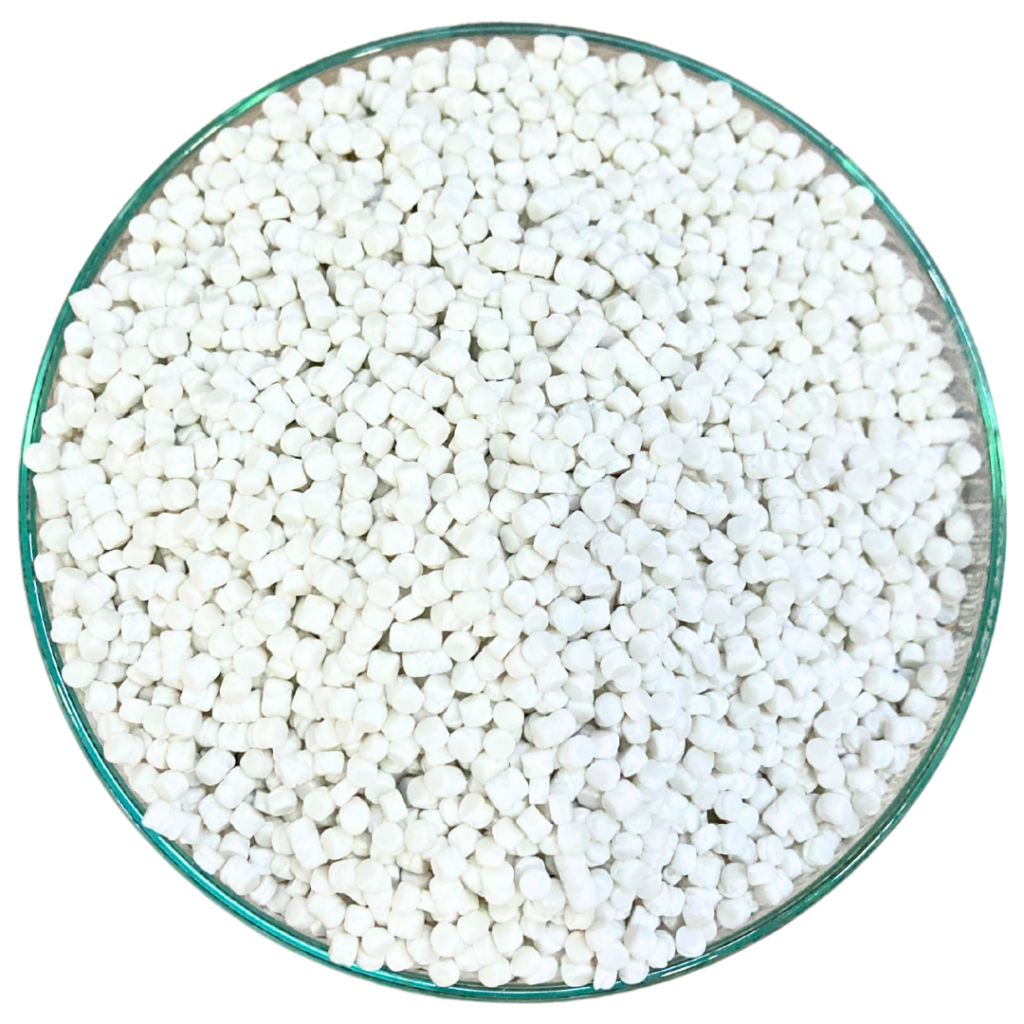
Plast Clear
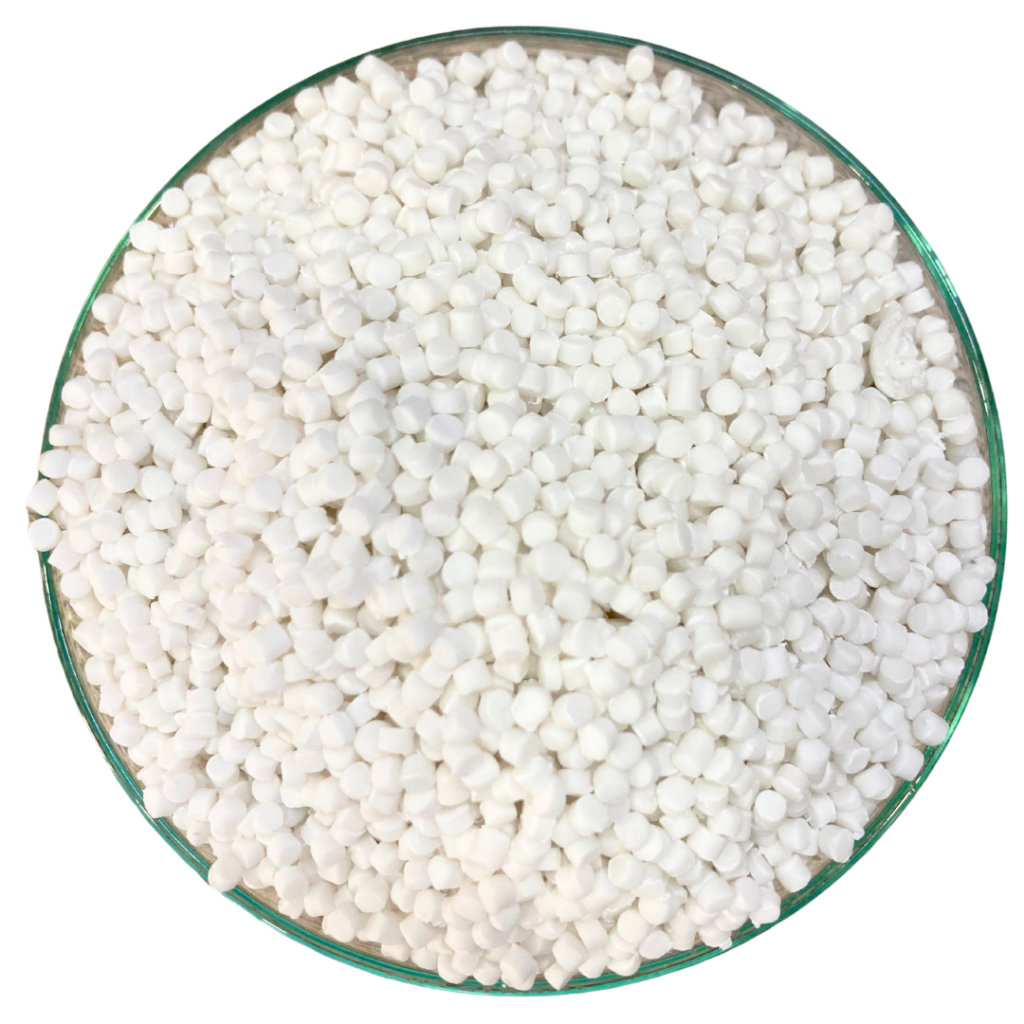
Plast Crystal
1. Why Transparent Fillers Exist in the First Place
Conventional filler masterbatches — calcium carbonate (CaCO₃) being the classic example — are excellent for opaque films (carry bags, garbage bags, non-wovens) where they reduce polymer consumption and improve stiffness. But CaCO₃’s refractive index diverges sharply from polyolefins (LDPE , LLDPE, HDPE , so above roughly 3–5% loading it starts scattering visible light at the filler–polymer interface. The result is haze, loss of gloss, and a “milky” film — unacceptable for stretch film, cast film, and printed packaging film where clarity sells the product inside.
Transparent fillers solve this by selecting mineral phases whose refractive index is much closer to the host resin, and by controlling particle size down into the sub-micron/fine-micron range so that any residual scattering falls below the wavelength threshold the human eye perceives as haze. This lets converters load filler at commercially meaningful percentages while keeping optical properties within spec.
Bajaj Plast’s two transparent grades approach this problem through two different mineral chemistries — sodium Sulphate and talc — each with a distinct mechanism, cost profile, and best-fit application.

2. Plast Crystal — Sodium Sulphate (Na₂SO₄) Based Transparent Filler
2.1 Composition and Chemistry
Plast Crystal is built around anhydrous sodium Sulphate (Na₂SO₄), an ultra-fine, high-purity inorganic powder, compounded into a virgin polyethylene carrier resin along with dispersion and process additives. Sodium Sulphate’s refractive index sits very close to that of PE, which is the fundamental reason this chemistry can be loaded at relatively high percentages while retaining film clarity.
Key technical attributes typically associated with this class of sodium-Sulphate masterbatch:
Ultra-fine, narrow particle size distribution
minimizes light-scattering centers and reduces the risk of “fish-eyes” or gel-like defects during extrusion.
PE carrier system
chosen for compatibility across the polyolefin family (LDPE, LLDPE, HDPE, PP) and with recycled/reprocessed polymer streams.
Surface-treated particles
improves wetting and bonding at the polymer–filler interface, which is directly tied to retained tensile strength and elongation at break (poorly bonded filler particles act as stress concentrators and micro-voids).
Low coefficient of friction contribution
relevant for film slip/anti-block behavior on high-speed bagging and stretch-wrapping lines.

2.2 Mechanism in the Film
When Na₂SO₄ particles are dispersed through the polymer melt, three things happen simultaneously during film formation:
Volumetric dilution
every kilogram of masterbatch that replaces virgin resin reduces raw material cost per meter of film.
Refractive index matching
because the filler’s optical index is close to the polymer’s, the film retains high transparency and gloss even at meaningful loadings.
Interfacial reinforcement
good particle–matrix adhesion (aided by the surface treatment) means the filler doesn’t simply dilute mechanical properties; in well-formulated systems it can help maintain or even improve tensile strength, toughness, and puncture resistance versus a naive dilution model.

2.3 Best-Fit Applications
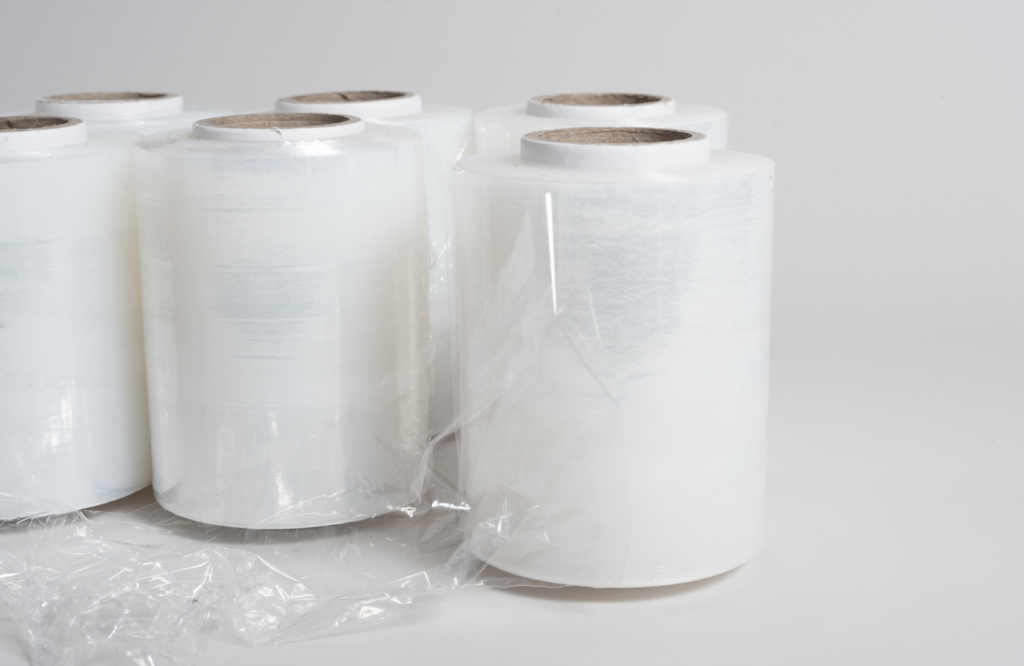
Stretch film / pallet wrap:
Requires high clarity for barcode/label visibility through multiple wraps, plus high elongation and cling. Plast Crystal’s fine particle size and PE compatibility make it suitable for LLDPE-based stretch film formulations at moderate loadings without compromising the film’s signature elastic recovery.
Cast PP/PE film:
Cast lines run at high line speeds with tight gauge control; a masterbatch with consistent particle size distribution avoids die lines and gauge-band defects.
General packaging & carry bag film:
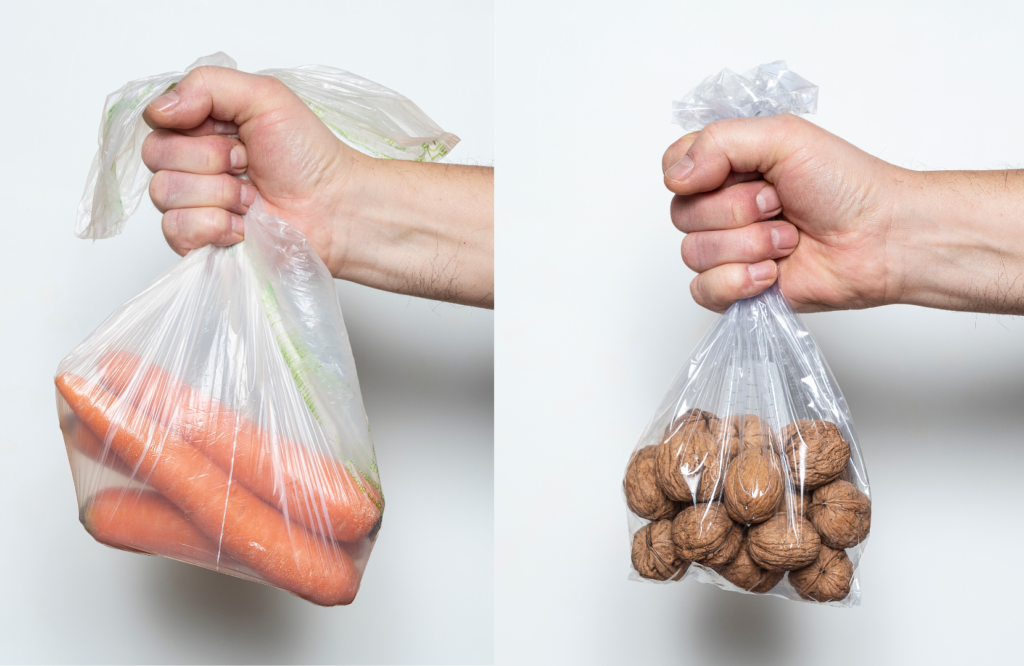
Where cost reduction is the primary driver and moderate transparency (rather than optical-grade clarity) is acceptable, this allows higher let-down ratios.
3. Plast Clear — Talc-Based Transparent Filler
3.1 Composition and Chemistry
Plast Clear uses a talc-based mineral filler (a hydrated magnesium silicate platy mineral), again compounded in a polyolefin carrier with performance additives. Talc’s crystal structure is fundamentally different from sodium Sulphate’s — it’s a platy (lamellar) mineral rather than a roughly equant particle, and this geometry is the source of its most distinctive functional benefit.
3.2 Mechanism: Nucleation, Not Just Dilution
The defining technical behavior of talc in polyolefins is its action as a nucleating agent:
Talc platelets provide a very high density of nucleation sites during melt cooling/crystallization, which shortens crystallization time and produces a finer, more uniform spherulitic structure in semi-crystalline polymers (PP, HDPE, LDPE).
A finer, more homogeneous crystalline morphology translates into measurable process and product benefits:
Faster cycle/cooling time on cast and blown lines
because crystallization is accelerated and more uniform, the film sets up faster after the die/chill roll, which can support higher output rates.
Improved dimensional stability
reduced post-extrusion shrinkage and warpage.
Higher stiffness/modulus
at a given gauge, which can allow gauge-down (down-gauging) without losing handling stiffness — a direct film-cost lever independent of resin substitution alone.
Reduced die/screw wear
relative to harder, more abrasive mineral fillers, contributing to lower maintenance costs on long production runs.
3.3 Talc vs. Sodium Sulphate — Different Levers
It’s worth being precise about the distinction: Plast Crystal’s primary value proposition is cost-effective bulk substitution with optical transparency preserved, driven by refractive-index matching. Plast Clear’s value proposition layers nucleation-driven process and mechanical benefits on top of the transparency and cost-saving function — it is doing more physical “work” in the polymer beyond simply being optically invisible.
3.4 Best-Fit Applications
It’s worth being precise about the distinction: Plast Crystal’s primary value proposition is cost-effective bulk substitution with optical transparency preserved, driven by refractive-index matching. Plast Clear’s value proposition layers nucleation-driven process and mechanical benefits on top of the transparency and cost-saving function — it is doing more physical “work” in the polymer beyond simply being optically invisible.
Cast film and BOPP-adjacent processes:
where crystallization control affects both optical (haze/gloss) and mechanical (stiffness, tear) outcomes.
Carry bags and general-purpose packaging film:
where the stiffness boost from nucleation allows either a thinner gauge at equal handling feel, or a stiffer bag at the same gauge.
Applications sensitive to line productivity:
faster crystallization/cooling behavior can be leveraged for higher throughput on blown and cast lines without film distortion.

4. Side-by-Side Technical Comparison
| Parameter | Plast Crystal (Na₂SO₄) | Plast Clear (Talc) |
|---|---|---|
| Primary mineral | Anhydrous sodium Sulphate | Hydrated magnesium silicate (talc) |
| Particle morphology | Fine, near-equant | Platy / lamellar |
| Primary mechanism | Refractive-index matching + volume dilution | Nucleating agent + refractive-index matching |
| Carrier resin | Virgin PE | Polyolefin carrier (application-tuned) |
| Key optical benefit | High transparency at moderate–high loading | Transparency plus finer crystalline morphology |
| Key mechanical benefit | Retains tensile/elongation via good interfacial bonding | Improves stiffness/modulus, dimensional stability |
| Process-side benefit | Low CoF contribution, smooth dispersion | Faster crystallization → potential cycle-time/output gains |
| Best-fit films | Stretch film, cast film, general packaging film | Cast film, carry bags, gauge-sensitive applications |
| Polymer compatibility | LDPE, LLDPE, HDPE, PP, recycled polymers | LDPE, LLDPE, HDPE, PP |
5. Processing Considerations for Converters
Regardless of which chemistry is chosen, a few process-engineering principles govern successful use of transparent fillers in flexible film lines:
Let-down ratio tuning:
Start conservatively (commonly in the 3–10% range for optical-critical films like stretch film, and higher for less optically demanding carry-bag film) and validate haze/gloss against your specific resin grade and die gap before scaling up.
Moisture control:
Both mineral chemistries are hygroscopic to varying degrees. Masterbatch that has absorbed ambient moisture will generate melt-phase volatiles, leading to bubble instability in blown film and surface defects (pinholes, gels) in cast film. Store masterbatch in sealed, moisture-barrier packaging and condition per the supplier’s recommended drying protocol in humid environments.
Screw/die compatibility:
Fine mineral particles, even surface-treated ones, can be mildly abrasive over long runs. Periodic inspection of screw flights and die lips is good practice, particularly at higher let-down percentages.
Melt temperature profile:
Because talc-based grades influence crystallization kinetics, converters should re-optimize chill-roll or air-ring cooling parameters when switching from an unfilled or CaCO₃-filled formulation to a talc-nucleated one — the crystallization behavior is not simply “the same polymer with less resin.”
Recycled content streams:
Both grades are positioned as compatible with recycled/reprocessed polyolefins, which is increasingly relevant as EPR (Extended Producer Responsibility) regulations in India push converters toward higher recycled content in carry bags and packaging film — but recycled resin’s variable MFI and contamination load should be validated in trial runs before full commercial adoption.

6. The Economics Argument
The commercial logic for both products rests on the same macro trend: polyolefin resin pricing tracks crude oil and naphtha cycles, while mineral filler costs are comparatively stable and largely decoupled from petrochemical feedstock volatility. By formulating film with 5–20% transparent filler masterbatch in place of an equivalent quantity of virgin resin, converters can:
Reduce raw-material cost per kilogram of finished film,
Insulate margins somewhat from resin price spikes,
And, in the case of talc-based grades, potentially recover part of the substitution's mechanical "cost" through the stiffness and dimensional-stability gains from nucleation — rather than simply diluting properties.
The trade-off converters must always validate empirically is where the loading curve intersects an acceptable haze/gloss/mechanical-property floor for the specific end-use — stretch film’s optical and cling requirements are far less forgiving than a plain grocery carry bag, for instance.
7. Conclusion
Plast Crystal and Plast Clear represent two distinct but complementary engineering approaches to the same commercial problem — reducing virgin polymer consumption in flexible films without visibly compromising transparency. Plast Crystal’s sodium-Sulphate chemistry leans on close refractive-index matching to deliver a clean, cost-effective bulk substitution suited to stretch and cast film. Plast Clear’s talc chemistry adds a nucleation dimension on top of transparency, making it a strong candidate wherever stiffness, dimensional stability, or crystallization-driven line productivity matter as much as clarity.
For converters, the right choice is rarely “one or the other” in absolute terms — it’s a function of the specific film (stretch vs. cast vs. carry bag), the property that matters most for that SKU (elongation vs. modulus vs. optical clarity), and the line’s tolerance for adjusting cooling and let-down parameters during trials.
This article is a technical overview based on publicly available product information from Bajaj Plast. Converters should request current Technical Data Sheets (TDS) and Safety Data Sheets (SDS) and run line trials before finalizing formulations, as exact particle size distribution, additive packages, and recommended dosage ranges are proprietary and may be updated by the manufacturer.
About Bajaj Plast Pvt. Ltd.
Bajaj Plast Pvt. Ltd. is a leading manufacturer of high-quality masterbatch solutions, dedicated to innovation, sustainability, and excellence. With a strong focus on customer satisfaction and cutting-edge technology, we are committed to delivering superior products that meet the evolving needs of the polymer industry.
