
Desiccant Masterbatch for Recycled PE and PP: Engineering Moisture Control for Better Processing Quality
Introduction
Moisture control is an important part of processing recycled plastics, mineral-filled formulations and polyolefin compounds. Water carried into an extruder through raw materials can contribute to gas formation, surface defects and inconsistent product quality.
However, effective moisture management requires more than adding a moisture absorber. Processors must understand the source of water, the chemistry of the additive and the relationship between additive concentration, dispersion and processing conditions.
Desiccant masterbatch provides a practical method of controlling residual moisture during melt processing. This article examines its operating mechanism and explains how to evaluate it within a controlled production process.

1. Start with the Moisture Source and Defect Mechanism
Recycled feedstock can retain water after washing or collect moisture during transportation, storage and handling. Fillers, pigments and other formulation ingredients can introduce additional moisture into the processing line.
During melt processing, available water can contribute to gas pockets. As the melt passes through the die and pressure falls, these pockets may expand, producing bubbles, pinholes or local discontinuities.
The resulting defects depend on the application. Thin films may develop punctures, while thicker extruded or moulded products may show internal voids or surface imperfections. Desiccant additives address the moisture contribution to these problems.
Before changing the formulation, processors should establish whether moisture is actually responsible. Persistent fish eyes, for example, may originate from contamination or incompletely melted material. Increasing desiccant dosage cannot reliably correct those causes.

2. Reactive Moisture Capture: How Desiccant Masterbatch Works
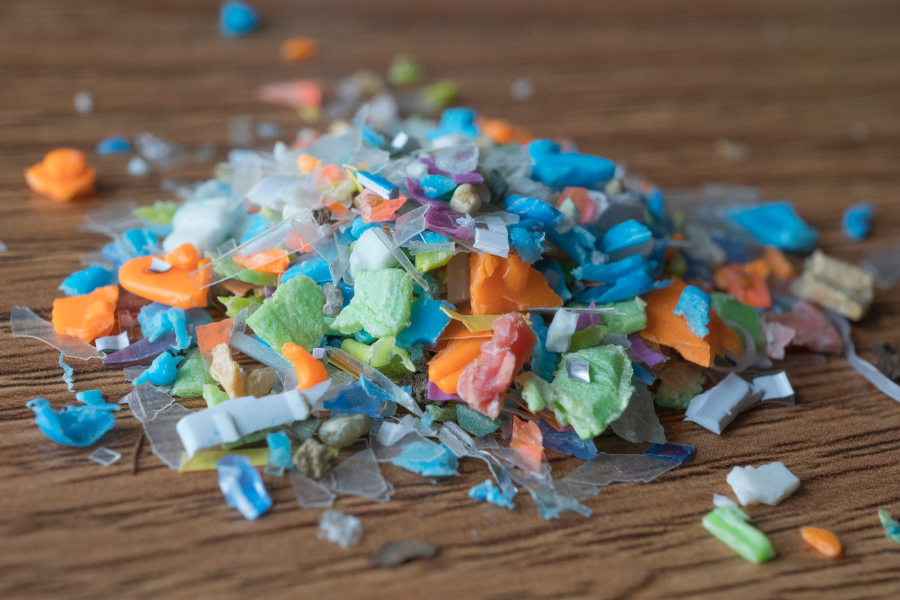
A desiccant masterbatch combines an active moisture-scavenging component with a polymer carrier. The carrier allows the additive to be handled as granules and distributed through the host polymer during processing.
Calcium oxide is a common active ingredient in reactive desiccant systems. Its moisture-binding mechanism follows the reaction:
CaO + H₂O → Ca(OH)₂ + heat
Water reacts with calcium oxide to form calcium hydroxide. This reduces the amount of free water available to contribute to vapour-related defects. The reaction product remains within the compound; the process binds water chemically rather than physically extracting it through an exhaust system.
The reaction also provides a useful theoretical distinction between active ingredient content and masterbatch moisture capacity.
Based on molecular masses, approximately 56.08 g of pure calcium oxide reacts with 18.02 g of water. Therefore, its theoretical water-binding capacity is approximately 0.321 kg of water per kilogram of pure CaO.
This calculated value is not a Bajaj product specification. Commercial masterbatch also contains carrier resin and potentially other ingredients. Actual usable capacity depends on active content, retained activity, dispersion and the processing conditions.
3. Grade Selection Must Consider the Complete Formulation
Desiccant masterbatch grades can differ in carrier chemistry, moisture capacity and intended application. Selection should therefore begin with the host polymer and processing method, rather than pellet appearance alone. Commercial manufacturers distinguish grades according to these factors.
For a technical evaluation, request the following information:
| Election parameter | Question to resolve |
|---|---|
| Carrier polymer | Is the carrier suitable for the base resin and finished-product requirements? |
| Moisture capacity | What capacity is declared, and under which test conditions? |
| Active chemistry | Does the grade chemically bind water or use another adsorption mechanism? |
| Dispersion | Can the additive be distributed adequately at the intended loading? |
| Processing guidance | What temperature and handling conditions does the supplier recommend? |
| Storage requirements | How should unopened and partially used packaging be protected? |

For thin films, the evaluation should also examine haze, visible specks and film integrity. For moulded products, assess surface finish and the required mechanical properties.
These checks prevent a successful reduction in moisture defects from becoming the only acceptance criterion.
4. Establish Dosage Through a Moisture Balance
A fixed addition percentage is unlikely to suit every raw-material batch. The required dosage depends on incoming moisture, additive capacity, formulation compatibility and process conditions. Controlled trials are necessary to establish an effective operating level.
A useful engineering starting point is:
Masterbatch required = water load to be captured ÷ effective moisture capacity
For this calculation:
-
Express the water load in kilograms.
-
Express effective capacity as kilograms of water captured per kilogram of masterbatch.
-
Keep the dosage basis consistent throughout the calculation.
The distinction between addition relative to the original feed and percentage of the final blend is important. For a base-feed mass B and masterbatch addition D:
Masterbatch concentration in the final blend (%) = 100 × D ÷ (B + D)
This mass balance supports trial planning; it does not replace the supplier’s processing guidance. A laboratory capacity value should not automatically be treated as fully available during a short extrusion residence time.
5. Match the Evaluation to the Application
Desiccant masterbatches are used in polyolefin processing applications including blown film, moulding and raffia production. Suitability depends on the selected grade and formulation.
The following evaluation framework helps connect moisture control to finished-product performance:
| Application | Suggested trial checks |
|---|---|
| PE carry bags and liners | Pinholes, bubble stability, film appearance and seal strength |
| Recycled PE or PP compounds | Pellet porosity, consistency and downstream processing behaviour |
| Injection-moulded components | Moisture-related streaking, surface appearance and mechanical performance |
| Raffia tapes | Tape breaks, draw stability and tensile properties |
| Extrusion coating and lamination | Coating continuity, pinholes and adhesion |
For multilayer structures, assess each layer formulation separately. A successful result in one recycled-content layer does not establish suitability for every layer of the film.

6. Integrate Desiccant Masterbatch into Process Control
A practical trial should isolate the effect of the additive while maintaining traceability.
Record a baseline.
Document the raw-material batch, blend composition, moisture result, output and defect frequency before introducing the trial change.
Follow the grade-specific addition guidance.
Keep dosing consistent and confirm that the additive is distributed through the feed.
Control other variables.
Avoid simultaneously changing the temperature profile, recycled-content percentage and additive concentration. Otherwise, the cause of any improvement becomes difficult to identify.
Evaluate the finished product.
Check the properties relevant to its actual use, rather than relying only on a smoother extrusion appearance.
Repeat with representative feedstock.
A result obtained from one unusually dry or clean batch may not represent routine production.
Storage is also part of this control strategy. Desiccant products require protection from moisture before use; follow the selected grade’s packaging, storage and handling instructions.

7. Measure Value Through Saleable Output
The economic value of a desiccant masterbatch should be assessed across the production process. Potential gains from lower rejection or fewer interruptions must be compared with additive cost and any changes in material preparation.
A useful internal metric is:
Production cost per kilogram of accepted product = total relevant production cost ÷ accepted output
Include resin, additives, energy, reprocessing and production losses within a consistent costing boundary.
Drying and desiccant addition can also work together. Where moisture loading is excessive, improve material preparation before attempting to compensate through higher additive addition. Any reduction in drying should be validated against product quality and stable production results.

8. Bajaj Masterbatch Solutions for Residual Moisture Management
Bajaj Masterbatch offers Plast Desiccant for managing moisture introduced through raw materials, fillers, pigments and other sources. Its product information identifies moisture-related film defects and silver streaking in moulded components among the processing issues it is designed to address.
For an application-specific discussion, share your polymer type, recycled-content level, filler loading, processing method and observed defects. Include measured moisture data and finished-product requirements wherever available.
This information supports a more focused grade evaluation and a trial programme based on measurable results.
Contact Bajaj Masterbatch to discuss desiccant masterbatch selection for your processing application.

About Bajaj Plast Pvt. Ltd.
Bajaj Plast Pvt. Ltd. is a leading manufacturer of high-quality masterbatch solutions, dedicated to innovation, sustainability, and excellence. With a strong focus on customer satisfaction and cutting-edge technology, we are committed to delivering superior products that meet the evolving needs of the polymer industry.

 BAJAJ PLAST PVT LTD