
Bajaj Plast TiO₂ White Masterbatch: A Technical Deep-Dive for Rigid Packaging Applications
Why TiO₂ White Masterbatch Matters in Rigid Packaging
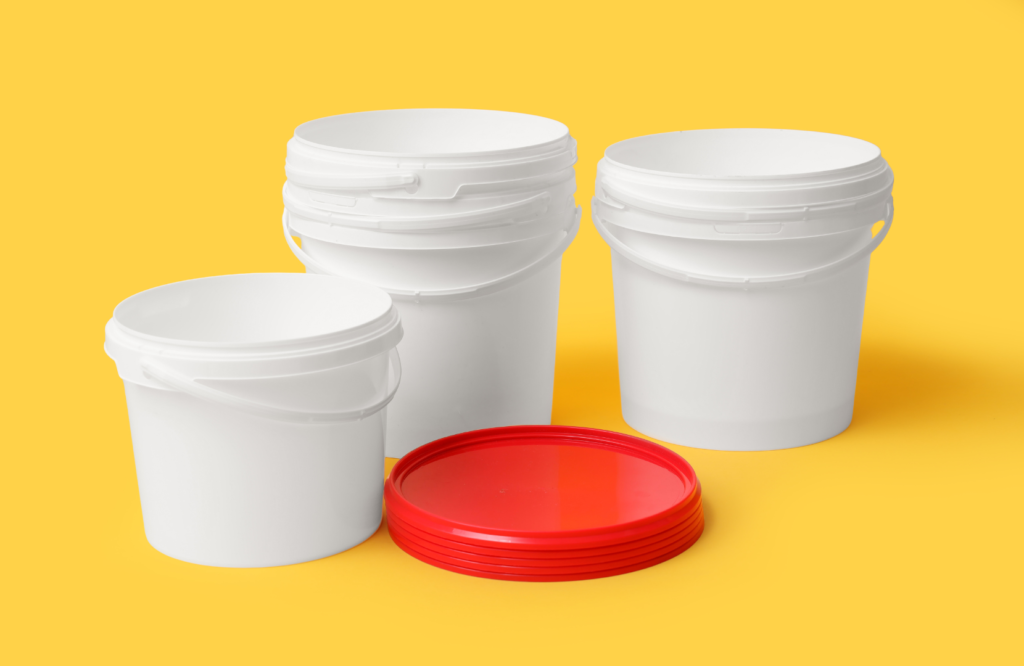
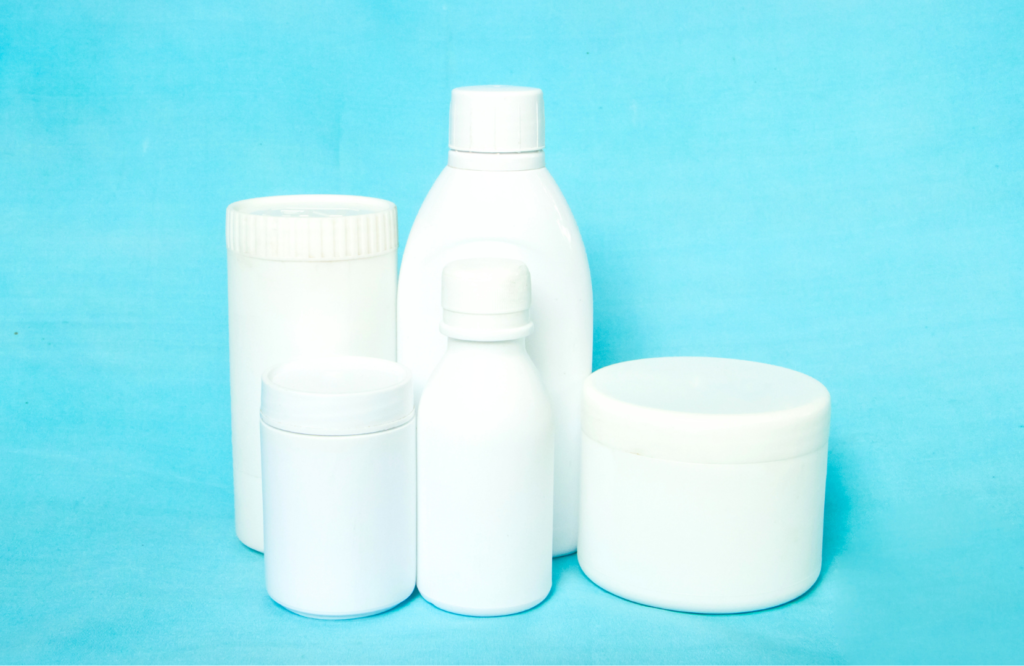
Every pail, jerry can, water tank, HDPE bottle, or household container that leaves a blow-molding or injection-molding shop has to solve three problems simultaneously: it must look consistently white and premium, it must hide the natural yellowish tint and any recycled content in the base resin, and it must survive years of UV exposure, mechanical stress, and chemical contact without chalking, cracking, or yellowing. TiO₂ (titanium dioxide) white masterbatch is the single most important input that determines whether a converter hits all three targets — or ends up with streaky, low-opacity, brittle containers that fail in the field.
Bajaj Plast, a Nagpur-based, ISO 9001:2015 (TUV Nord) certified masterbatch manufacturer with three decades of operating history, produces <cite index=”6-1″>White Masterbatches manufactured with state-of-the art technology, high quality TiO2 and polymers</cite>, offered across <cite index=”6-1″>PE, PP, PS and EVA base carriers</cite> so converters can match the masterbatch carrier to their process resin. This post breaks down the science behind these products and how to select and process them correctly for rigid packaging formats.
The Chemistry: Rutile vs. Anatase TiO₂
Titanium dioxide exists industrially in two crystal forms relevant to plastics: rutile and anatase. Rutile has the higher refractive index, giving it superior light-scattering efficiency, better durability, and significantly lower photocatalytic activity. Anatase, while slightly brighter/bluer in undertone, is more photoactive — meaning it can catalyze polymer chain degradation under UV exposure unless it is surface-treated.
For rigid packaging that sees outdoor storage, transport, or field use (jerry cans, water tanks, pails), rutile-grade TiO₂ with an inorganic surface coating (alumina/silica encapsulation) is the standard choice because it:
- Minimizes photocatalytic chain scission at the polymer surface (chalking resistance)
- Delivers higher hiding power per unit loading, which is cost-relevant since TiO₂ is the most expensive raw material in the formulation
- Offers better long-term color and gloss retention outdoors
Bajaj’s product literature confirms this durability focus, describing its Plast White Masterbatch’s main features as high weatherability properties, produced from various loadings of Titanium Dioxide and quality tested PE and PP base carriers.
The Physics of Opacity: Why Loading Level Isn't the Only Variable
Opacity in a TiO₂-filled polymer is governed by Mie scattering theory, not simple pigment concentration. Light scattering efficiency peaks when the TiO₂ particle diameter is roughly half the wavelength of visible light — around 200–250 nm. Particles that are too small scatter weakly (Rayleigh regime) and clump together; particles that are too large scatter inefficiently and increase resin usage without a proportional opacity gain.
This means three formulation variables interact to determine final container whiteness and hiding power:
Particle size distribution and dispersion quality
poor dispersion creates agglomerates that behave optically like fewer, larger particles, wasting scattering potential and causing visible specks or streaks in the wall of a bottle or tank.
TiO₂ loading (%)
Bajaj’s product range has grades starting from 50% to 75% of TiO2 depending on the customer’s end application requirement, allowing converters to dial in opacity against cost.
Wall thickness of the finished part
a 3 mm pail wall needs far less TiO₂ per kg of resin to achieve full hiding than a 0.3 mm thin-wall HDPE bottle, because hiding power is a function of both concentration and optical path length.
For thick-wall parts like pails and water tanks, converters can often use lower let-down ratios (2–3% masterbatch) since the thick section itself contributes scattering path length. For thin-wall bottles and small cans, a higher masterbatch percentage or a higher-TiO₂-content grade (65–75%) is usually required to avoid “see-through” or grey-cast defects.
Dispersion Quality: The Real Differentiator Between Masterbatch Suppliers
TiO₂ primary particles want to agglomerate due to high surface energy. The masterbatch manufacturing process — twin-screw extrusion with controlled shear, dispersing agents, and wetting aids — determines whether that agglomeration is broken down and kept apart in the carrier resin matrix. Bajaj emphasizes this directly, noting that uniform dispersion of the pigment guarantees a smooth and consistent white tone, free from streaks or spots, even in thin film applications, and that its process delivers exceptional optical performance, thermal integrity, and polymer processing compatibility in both commodity and engineering thermoplastics.
Poor dispersion shows up as specific, diagnosable defects on rigid packaging:
Fish-eyes / specks
on jerry can and bottle surfaces — undispersed agglomerates acting as stress concentrators and optical defects
Die lines and streaking
in blown containers and extrusion blow-molded tanks
Inconsistent opacity across a lot
batch-to-batch dispersion variance shows as visible whiteness/yellowness (YI) drift
Reduced impact strength
agglomerates act as micro-notches, a critical failure mode for pails and jerry cans that must survive drop tests
Carrier Resin Selection: Matching the Masterbatch to the Process Resin
Carrier resin compatibility is not cosmetic — it affects melt flow matching, weld-line strength, and dispersion homogeneity during let-down. Bajaj’s own technical guidance is explicit that the carrier resin must be compatible with the final application resin to ensure proper incorporation and color development and its production lines accommodate various carrier resin types, offering flexibility for different application requirements.
Practical carrier-matching guidance for rigid packaging:
| Application | Base Resin | Recommended Carrier | Process Consideration |
|---|---|---|---|
| Pail containers (5L–25L) | HDPE / PP (injection molded) | HDPE or PP carrier, MFI matched | High-shear injection needs good thermal stability to avoid TiO₂ discoloration at longer residence times |
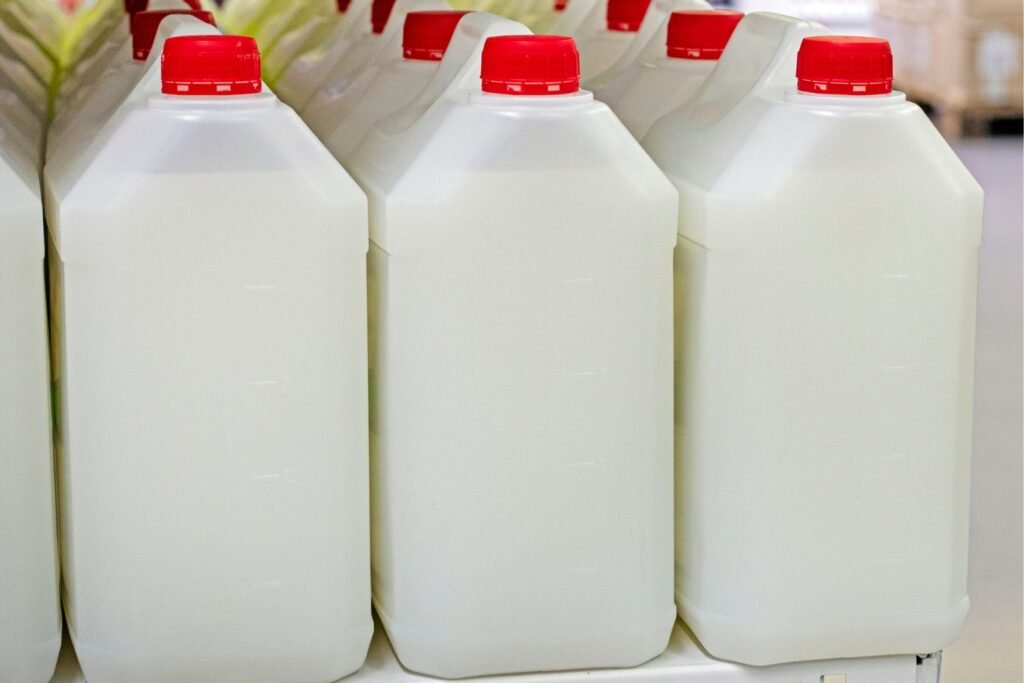
| Jerry cans | HDPE (extrusion blow molded) | HDPE carrier | Parison sag control; masterbatch MFI must not disturb parison swell |
| Water tanks (rotomolded or blow molded) | HDPE / LLDPE | HDPE carrier, low-MFI matched to roto-grade resin | Long thermal cycles in rotomolding demand high heat-stability TiO₂ coating to prevent yellowing |
| HDPE bottles | HDPE (blow molded) | HDPE carrier | Thin-wall hiding power is the priority driver of TiO₂ loading choice |
| Small cans / household containers | PP / HDPE (injection molded) | PP or HDPE carrier matched to base | Surface gloss and print-base whiteness are key aesthetic KPIs |
A mismatched carrier (e.g., a PP carrier let down into an HDPE jerry can resin) can cause poor melt homogenization, visible carrier-rich streaks, and localized weak points along parison weld lines — a serious concern for jerry cans and pails that must pass drop and stack-load tests.
Application-by-Application Technical Notes
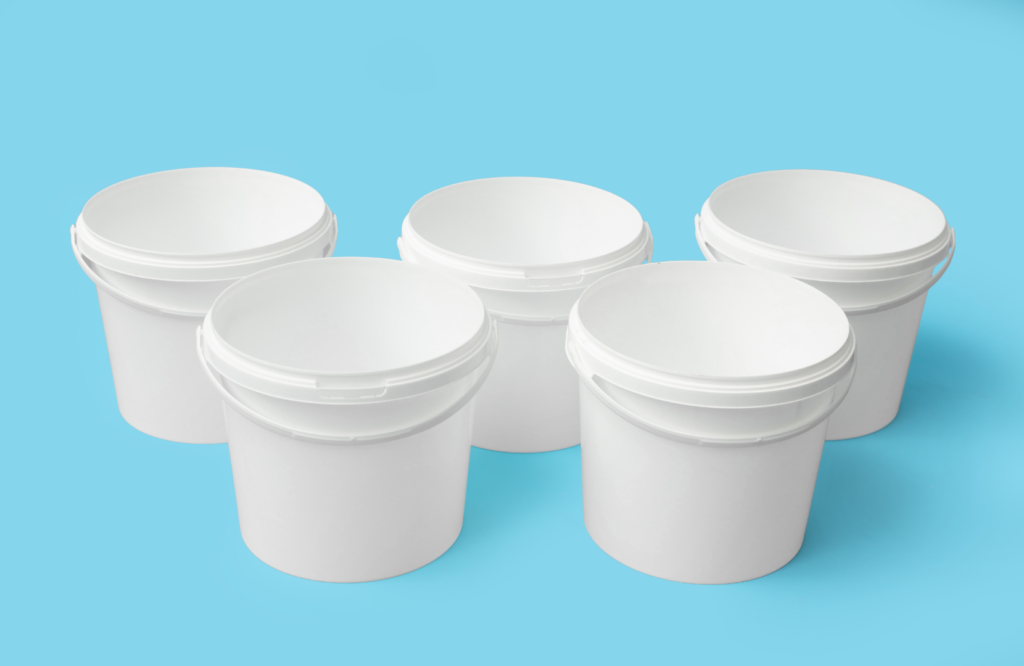
Pail containers.
Injection-molded pails need fast cycle times and consistent wall thickness. TiO₂ masterbatch here must disperse fully within short residence times in the barrel; poor thermal stability shows up as a grey or yellow cast concentrated near the gate. Since pails often carry industrial or food contents, food-contact-grade, low heavy-metal-impurity TiO₂ grades are typically specified.
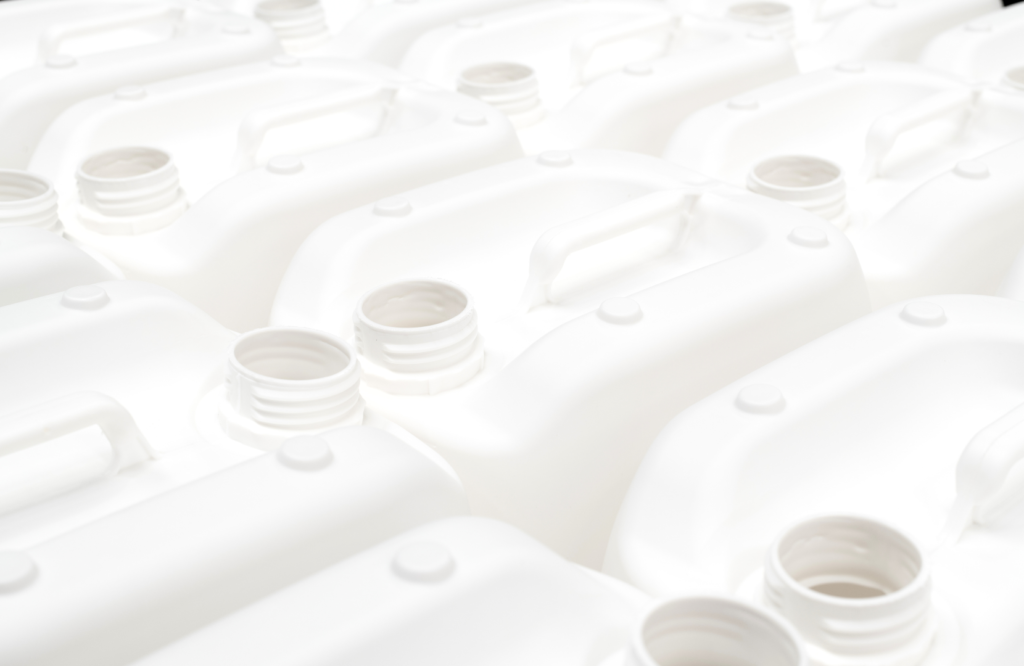
Jerry cans.
Extrusion blow molding subjects the masterbatch to parison drawdown and blow-up ratio stresses. Whiteness must remain uniform across the shoulder, handle, and base — geometrically the thinnest and thickest zones of the part — meaning dispersion consistency across the melt cross-section is more critical here than in simpler geometries.
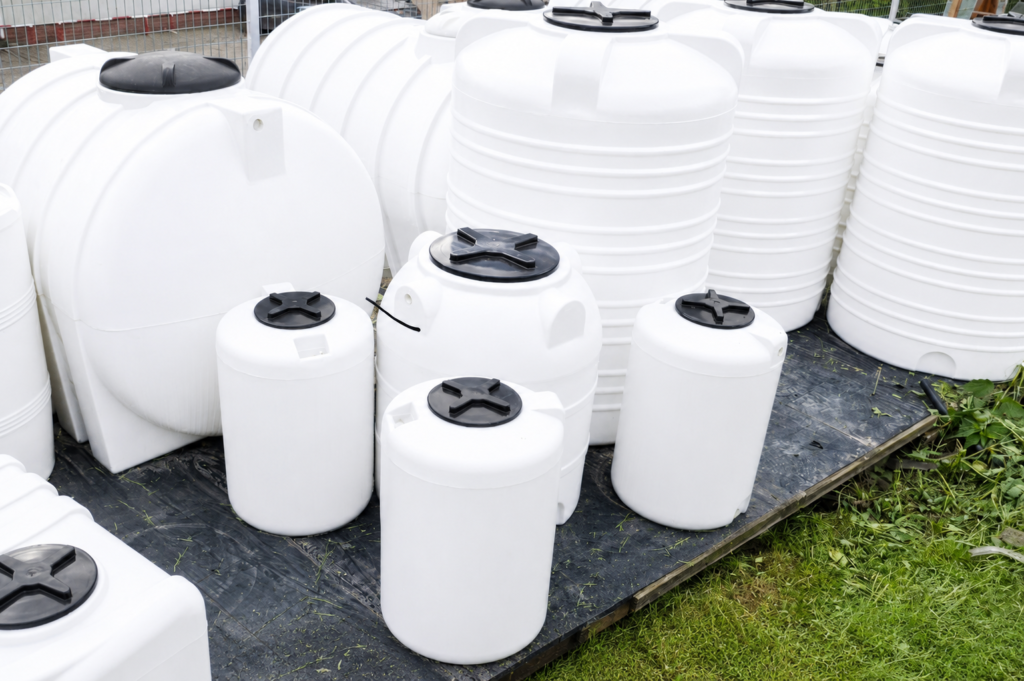
Water tanks.
Whether extrusion blow molded or rotomolded, tanks are the most UV-exposure-intensive rigid packaging format, often installed outdoors for years. This is where rutile TiO₂ with strong photocatalytic-suppression coating earns its premium — it directly extends the service life before chalking, embrittlement, and micro-cracking under UV/thermal cycling. Bajaj’s positioning around high weatherability properties is most relevant to this application segment specifically.
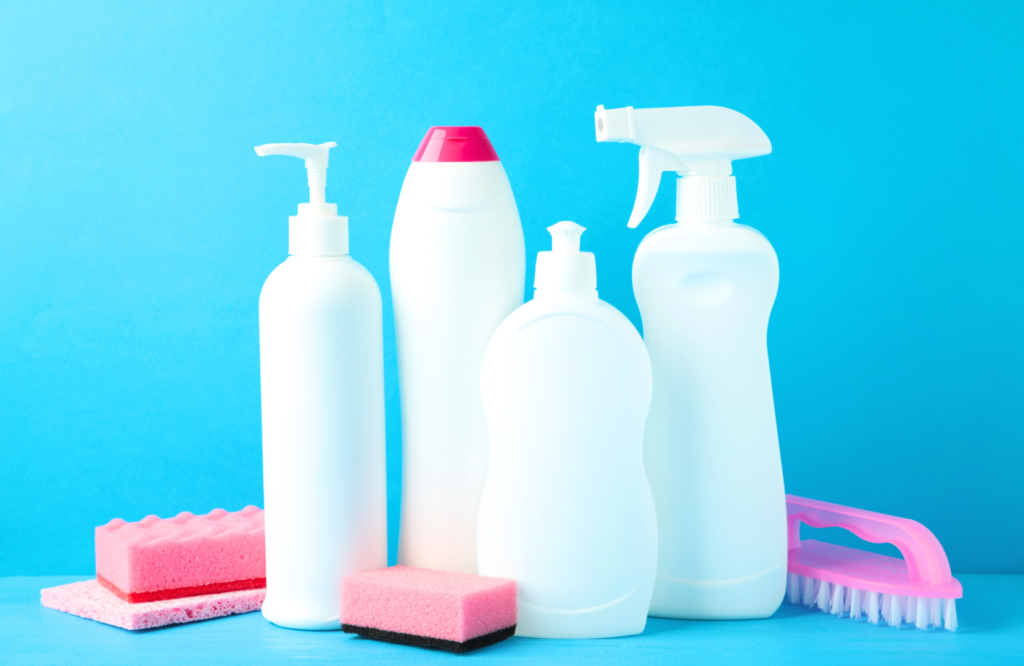
HDPE bottles.
Thin-wall hiding power is the dominant technical constraint. Converters typically need either a higher TiO₂-loading grade (65–75%) or a higher let-down percentage to avoid the “grey see-through” defect common with under-loaded thin sections, especially at bottle shoulders where wall thickness naturally thins during blow molding.
Small cans and household containers.
These are largely aesthetic-performance-driven — surface gloss, whiteness index, and print/label adhesion base quality matter as much as opacity. Bluish-white undertone options (vs. pure white) are often chosen here for perceived “cleaner” shelf appeal — Bajaj offers both, noting its clients can select the right grade of their choice, offering pure whites and also with bluish tone.
Key Quality Parameters Converters Should Specify
When qualifying a TiO₂ masterbatch for rigid packaging, request data (or a TDS) covering:
TiO₂ content (%) and crystal form (rutile vs. anatase)
Yellowness Index (YI) and Whiteness Index on a standardized plaque
Carrier resin MFI, matched to base resin processing window
Dispersion rating (often assessed via filter-pressure-value test or microscopy of pressed film)
Heat stability — color retention after extended residence time simulating multi-pass or rotomolding cycles
Food-contact compliance documentation, where relevant (pails, bottles, small cans used for consumables)
Practical Selection Framework
- Match carrier resin to base polymer (HDPE-in-HDPE, PP-in-PP) as a non-negotiable first filter.
- Choose TiO₂ loading grade based on wall thickness — thin-wall bottles and small cans lean toward 65–75% grades; thick-wall pails and tanks can often use 50–60% grades economically.
- For any outdoor-exposed part (tanks, jerry cans left in yards, agricultural containers), insist on rutile-grade, surface-treated TiO₂ with demonstrated weatherability data — not just initial whiteness.
- Request dispersion and YI consistency data across multiple production lots, not a single certificate of analysis, since batch-to-batch consistency is what prevents visible color drift across a production run.
- Validate with a pilot run at production-line residence times and shear conditions before locking in a full-scale changeover — masterbatch performance on a lab extruder does not always replicate on high-output blow-molding or injection lines.
Closing Note
TiO₂ white masterbatch selection for rigid packaging is a materials-science decision, not just a color match. Crystal form, particle dispersion, carrier compatibility, and heat/UV stability collectively determine whether a pail, jerry can, tank, bottle, or household container holds its whiteness and structural integrity for its intended service life. Bajaj Plast’s positioning — three decades of manufacturing experience, ISO 9001:2015/TUV Nord certification, and a stated range of grades from 50% to 75% TiO2 across multiple carrier resins — reflects the kind of formulation flexibility rigid-packaging converters need to match masterbatch to specific process and end-use requirements rather than using a one-size-fits-all grade.
For product-specific technical data sheets, exact TiO₂ percentages, and current certifications, request the TDS directly from Bajaj Plast, as formulations and grade ranges are periodically updated.
About Bajaj Plast Pvt. Ltd.
Bajaj Plast Pvt. Ltd. is a leading manufacturer of high-quality masterbatch solutions, dedicated to innovation, sustainability, and excellence. With a strong focus on customer satisfaction and cutting-edge technology, we are committed to delivering superior products that meet the evolving needs of the polymer industry.

 BAJAJ PLAST PVT LTD