
Why Moisture Causes Bubbles in Recycled Plastic & How Desiccant Masterbatch Helps
In the recycled plastic industry, moisture contamination is one of the most underestimated causes of processing defects. For B2B manufacturers, purchase managers, and plant operators, moisture-related issues directly impact product quality, machine efficiency, rejection rates, and profitability.
One of the most visible and costly problems? Bubbles, voids, and surface defects in recycled plastic products.
This blog explains:
Why moisture causes bubbles in recycled plastic
The technical mechanism behind vapor formation
How desiccant masterbatch works at a molecular level
How to select the right desiccant masterbatch for industrial applications
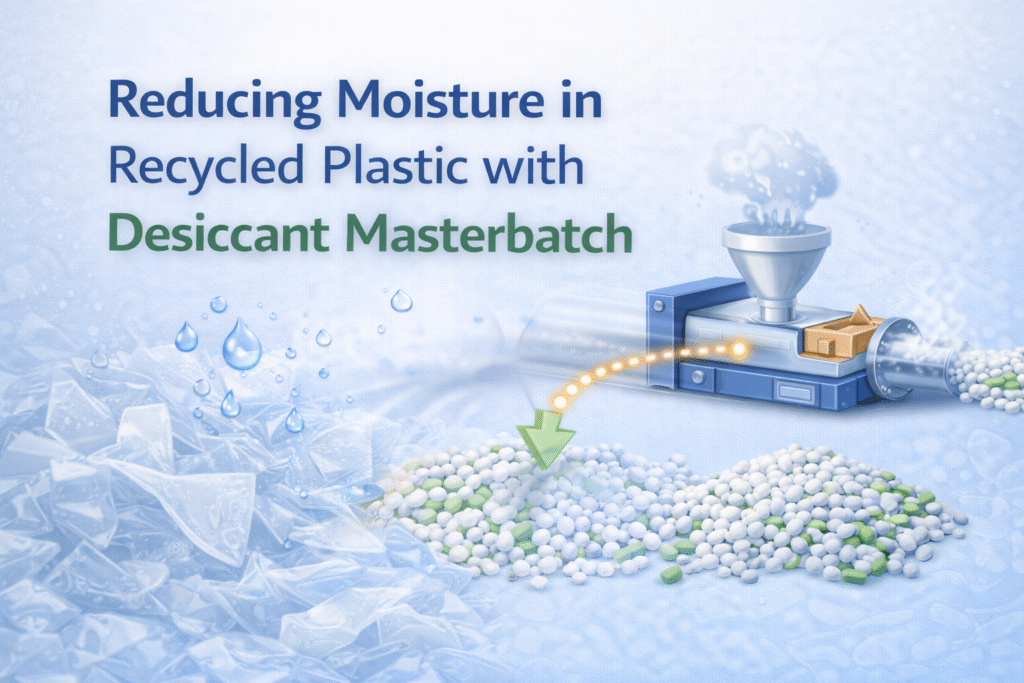
Understanding the Moisture Problem in Recycled Plastic
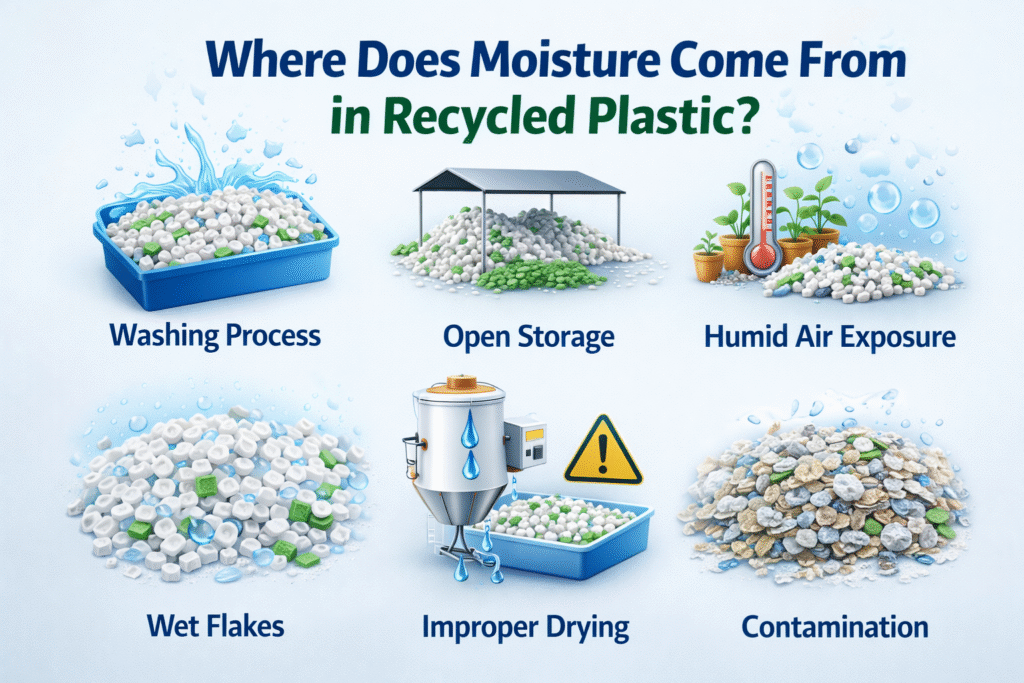
Unlike virgin polymers, recycled plastic contains higher moisture levels due to:
Washing processes during recycling
Open-air storage of flakes or granules
Hygroscopic polymer structures
Contaminated scrap streams
Improper drying before extrusion
Common moisture-affected polymers:
Recycled LDPE / LLDPE
Reprocessed HDPE
Recycled PP raffia & woven sack material
PET regrind
Multilayer recycled blends
Even 0.1%–0.3% moisture content can cause severe defects during extrusion or molding.
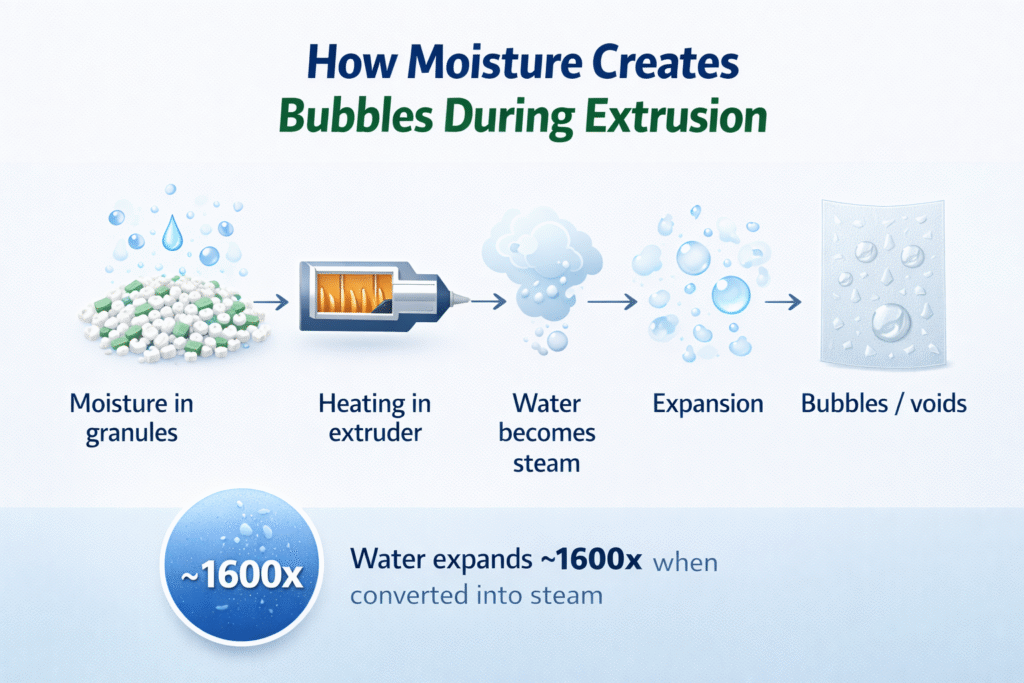
How Moisture Causes Bubbles in Recycled Plastic
When recycled plastic is processed in an extruder or molding machine, temperatures typically range between 160°C to 280°C, depending on the polymer.
At these temperatures:
1.Water Converts into Steam
Moisture trapped inside the polymer matrix rapidly vaporizes.
Water expands nearly 1600 times in volume when converted into steam.
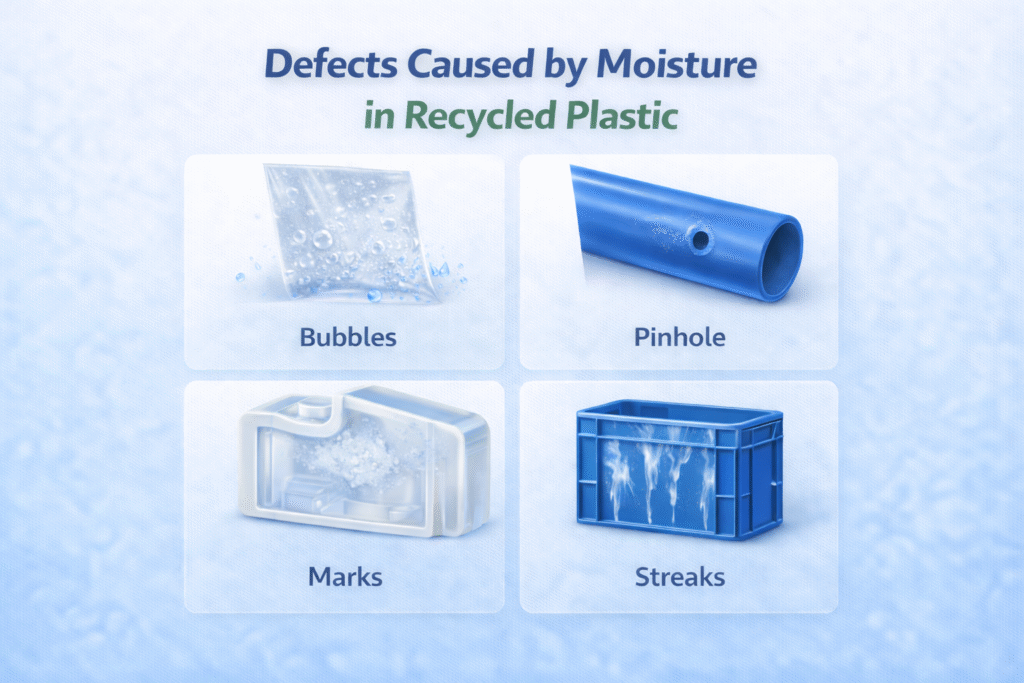
This expansion creates:
Micro-voids
Internal bubbles
Surface blistering
Pinholes in films
Silver streaking in molded parts
2.Hydrolytic Degradation (In Hygroscopic Polymers)
For polymers like PET, Nylon, and some recycled engineering plastics:
Moisture causes hydrolysis, breaking polymer chains.
Result:
Reduced molecular weight
Lower tensile strength
Brittleness
Poor elongation
Reduced impact resistance
This is a major concern for B2B buyers supplying automotive, packaging, or infrastructure sectors.
3.Processing Instability
Moisture leads to:
Melt fracture
Unstable melt pressure
Irregular bubble formation in blown film
Die drool
Poor surface finish
Inconsistent thickness
For purchase managers, this translates to:
Higher rejection rates
Increased machine downtime
Increased energy cost
Customer complaints
Why Traditional Drying Is Not Always Enough
Many recyclers rely on:
Hot air drying
Hopper dryers
Sun drying
Inline drying systems
However, in recycled plastics:
Moisture is often chemically trapped
Contaminants hold water internally
Irregular flake sizes prevent uniform drying
High ambient humidity reintroduces moisture
This is where Desiccant Masterbatch becomes critical.
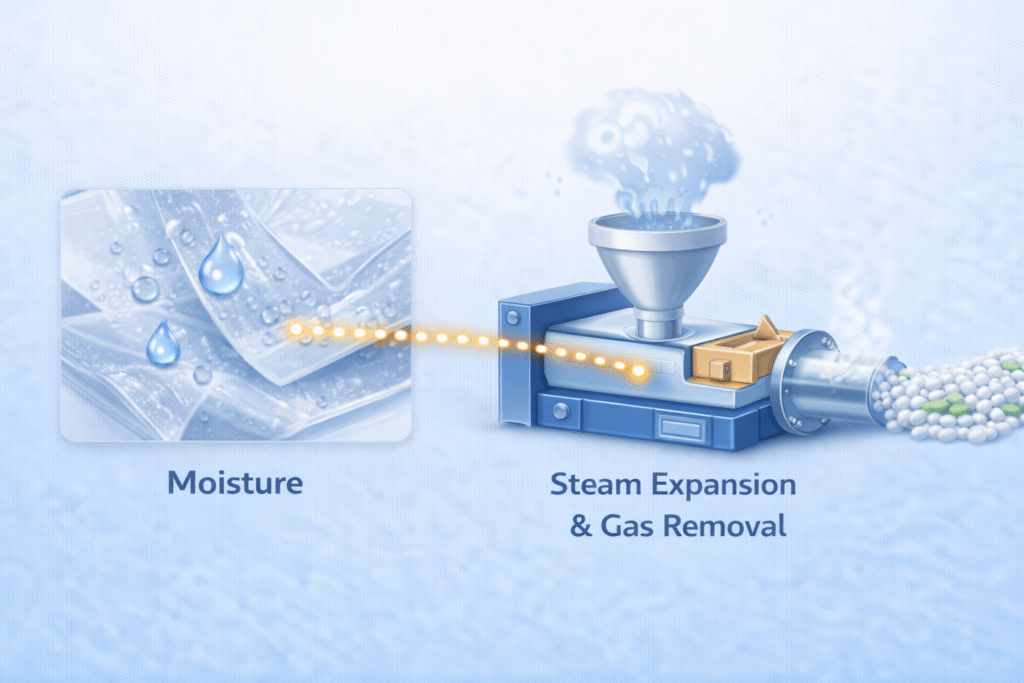
What is Desiccant Masterbatch?
Desiccant Masterbatch is a specially formulated additive masterbatch designed to absorb and neutralize moisture during processing.
It is typically composed of:
High-efficiency moisture absorbers (e.g., calcium oxide-based compounds)
Carrier resin compatible with base polymer
Processing stabilizers
- It is added directly into the extruder along with recycled plastic.
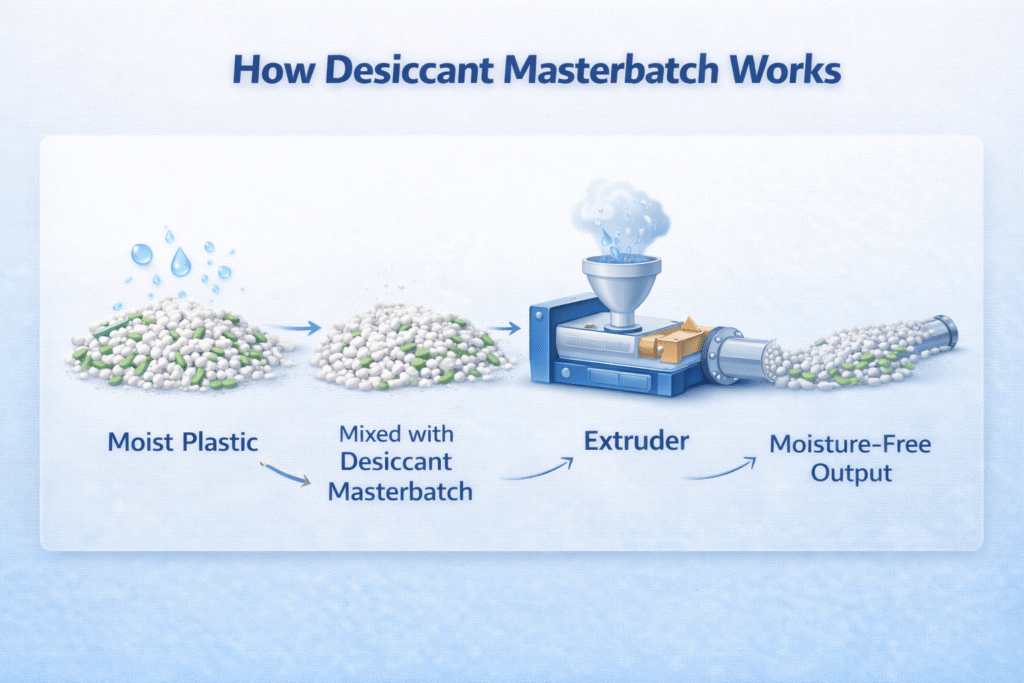
How Desiccant Masterbatch Works (Technical Mechanism)
The working principle involves a chemical absorption reaction, not just physical adsorption.
Step 1: Moisture Activation
At processing temperatures, trapped moisture is released inside the melt.
Step 2: Chemical Reaction
Desiccant particles react with water molecules to form stable hydroxides.
Example reaction:
CaO + H₂O → Ca(OH)₂
This reaction:
Prevents steam formation
Eliminates vapor expansion
Stops bubble formation
Step 3: Stable Dispersion
The reaction byproduct remains finely dispersed within the polymer matrix without affecting surface finish when used at recommended dosages.
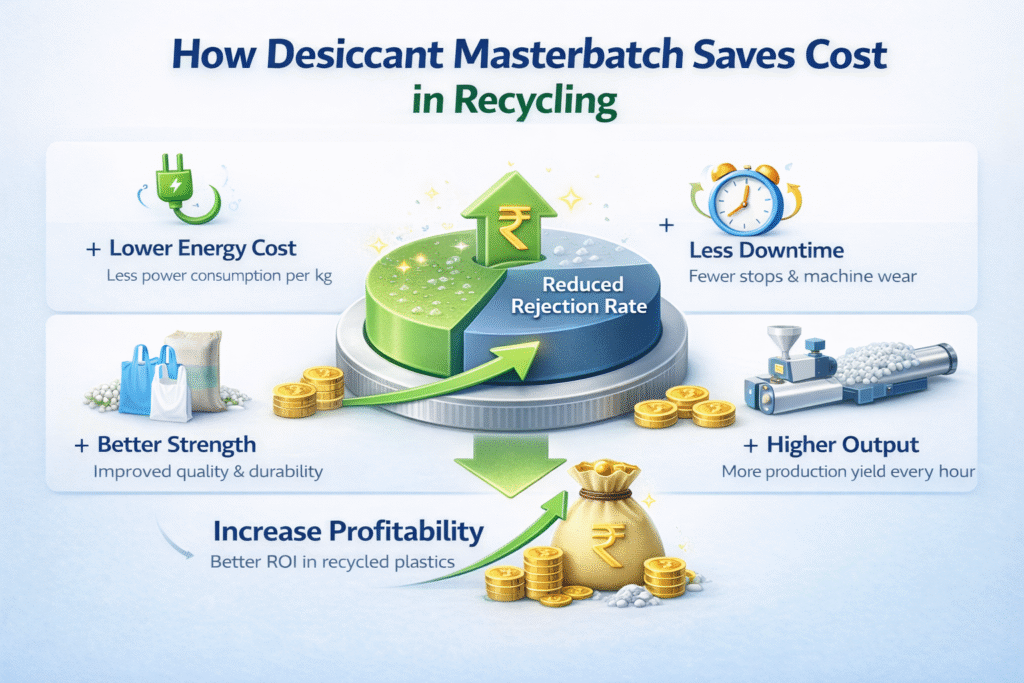
Benefits of Using Desiccant Masterbatch in Recycled Plastic
For B2B manufacturers and procurement teams, the advantages are measurable:
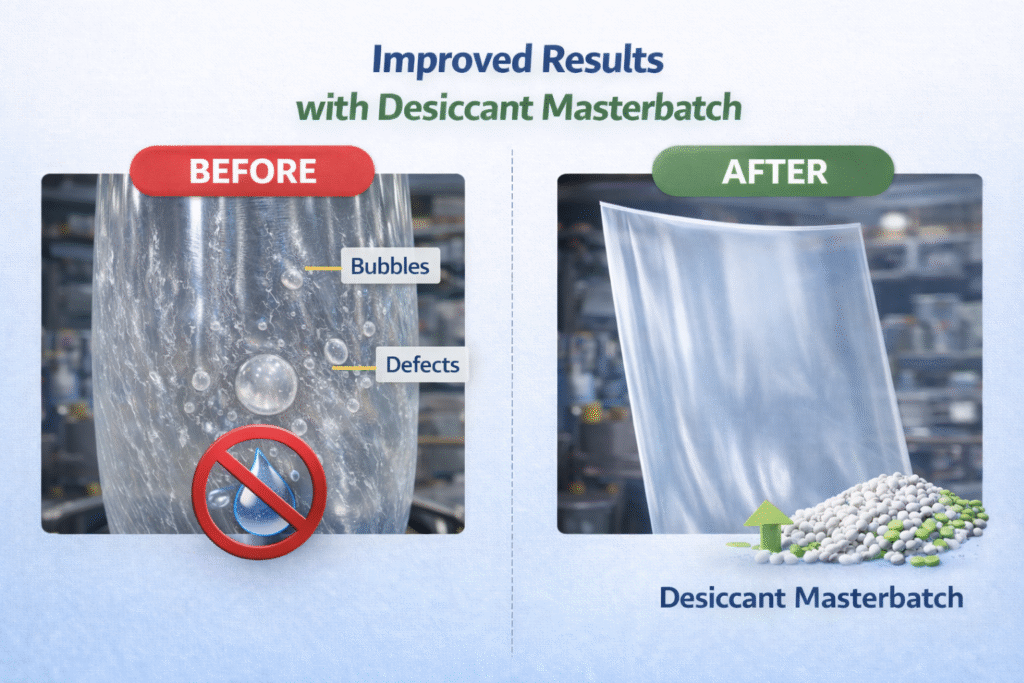
Eliminates Surface Bubbles & Voids
Ensures smooth finish in:
Blown films
Carry bags
Drip irrigation pipes
Molded crates
Garbage bags
Improves Mechanical Strength
Prevents hydrolytic degradation in moisture-sensitive polymers.
Reduces Rejection Rates
Lower scrap generation = higher profitability.
Improves Process Stability
Stable melt pressure
Better bubble stability in blown film
Reduced die build-up
Cost-Effective Alternative to Advanced Drying Systems
Reduces dependency on:
High-energy dryers
Pre-drying equipment
Long drying cycles
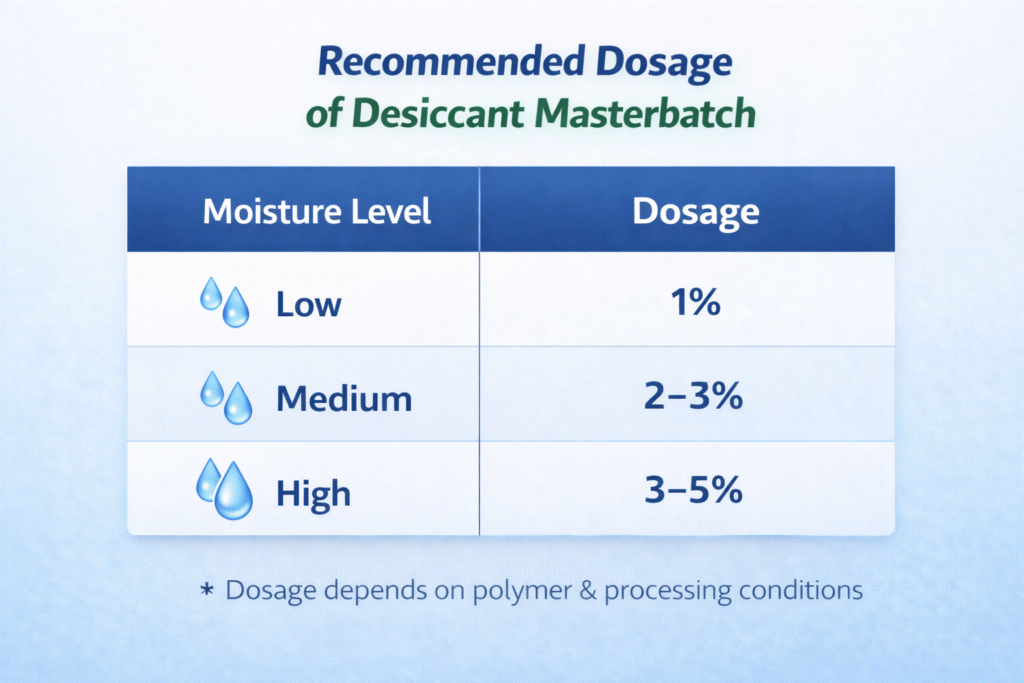
Recommended Dosage for Industrial Use
Typical dosage range:
1% to 3% for moderate moisture levels
3% to 5% for high moisture recycled content
Exact dosage depends on:
Polymer type
Moisture level
End application
Processing temperature
For B2B purchase managers, requesting a technical trial sample before bulk procurement is recommended.
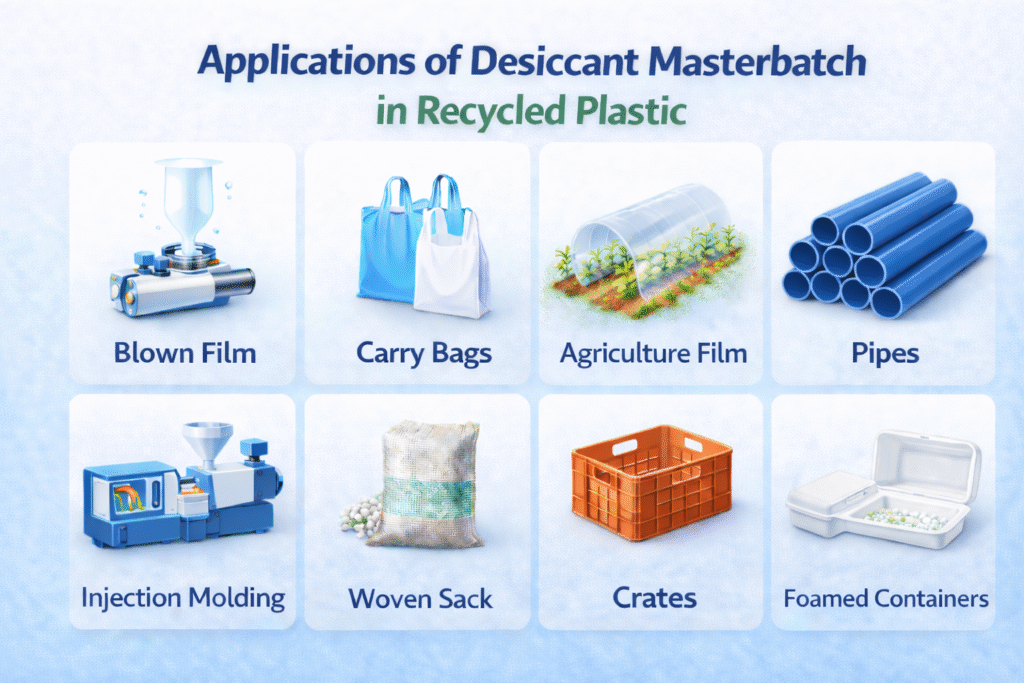
Applications Where Desiccant Masterbatch is Essential
Recycled LDPE film manufacturing
Garbage bags production
Multilayer recycled films
Injection molded recycled crates
Agricultural pipes
Woven sacks (PP raffia)
Recycling plants using high regrind ratios
ROI Perspective for Purchase Managers
Let’s quantify the impact:
Without desiccant masterbatch:
5%–8% rejection due to bubbles
Increased power consumption
Machine downtime
Customer return claims
With proper dosage:
Rejection reduces to <1%
Higher production output
Improved customer satisfaction
Lower operational cost per kg
Even a 1% reduction in rejection in a 1000 MT/month plant can generate significant savings.
How to Select the Right Desiccant Masterbatch Supplier
When sourcing desiccant masterbatch, evaluate:
Absorption efficiency (lab-tested data)
Compatibility with LDPE/HDPE/PP
Dispersion quality
Ash content
Effect on mechanical properties
Long-term storage stability
Consistent particle size
Avoid low-quality desiccants that:
Increase brittleness
Cause black specks
Increase die pressure
Affect transparency
Conclusion
Moisture in recycled plastic is not just a minor processing issue — it is a profitability risk for manufacturers.
Bubbles, voids, and hydrolytic degradation directly impact:
Product quality
Customer trust
Production efficiency
Operational margins
A high-quality Desiccant Masterbatch for recycled plastic acts as an in-process moisture neutralizer, ensuring stable extrusion, superior surface finish, and consistent mechanical properties.
For B2B manufacturers and purchase managers, it is not an expense — it is a process optimization tool that safeguards production efficiency and brand reputation.
About Bajaj Plast Pvt. Ltd.
Bajaj Plast Pvt. Ltd. is a leading manufacturer of high-quality masterbatch solutions, dedicated to innovation, sustainability, and excellence. With a strong focus on customer satisfaction and cutting-edge technology, we are committed to delivering superior products that meet the evolving needs of the polymer industry.
