
Quality Complaints in Masterbatch: Root Cause Analysis and Prevention Strategies
In the plastics value chain, masterbatch quality complaints are more than a routine operational issue—they directly impact production efficiency, final product aesthetics, mechanical performance, and brand reputation.
For B2B buyers, procurement heads, and plant managers, understanding why these complaints arise and how to prevent them is critical to controlling costs and ensuring consistent output.
This blog dives deep into the technical root causes of masterbatch quality complaints and outlines proven prevention strategies used by high-performing manufacturers.
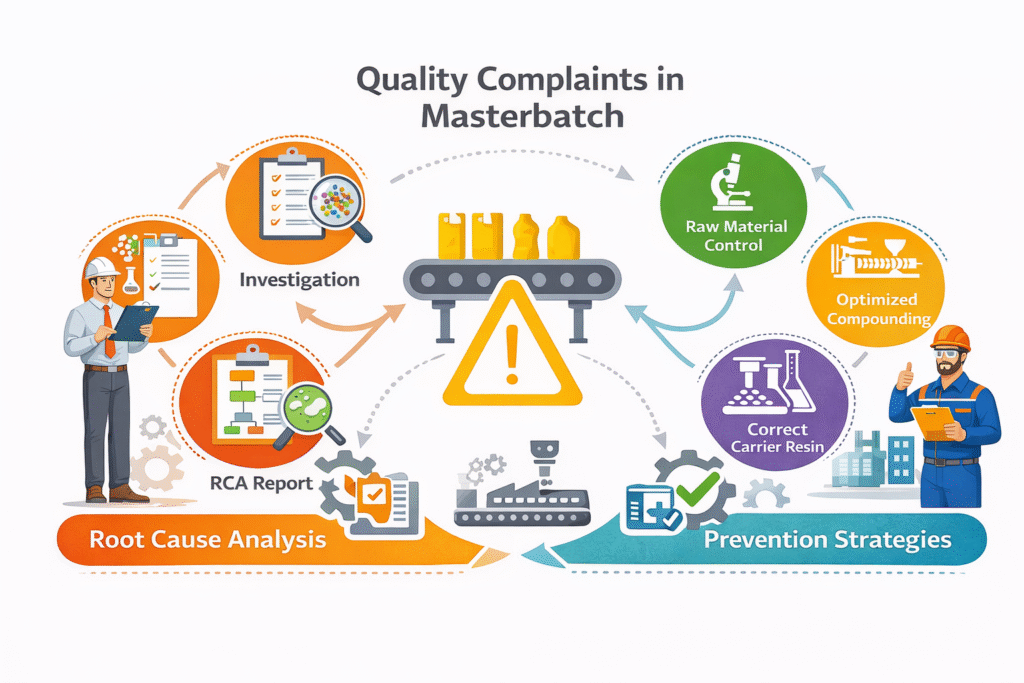
Why Quality Complaints in Masterbatch Matter
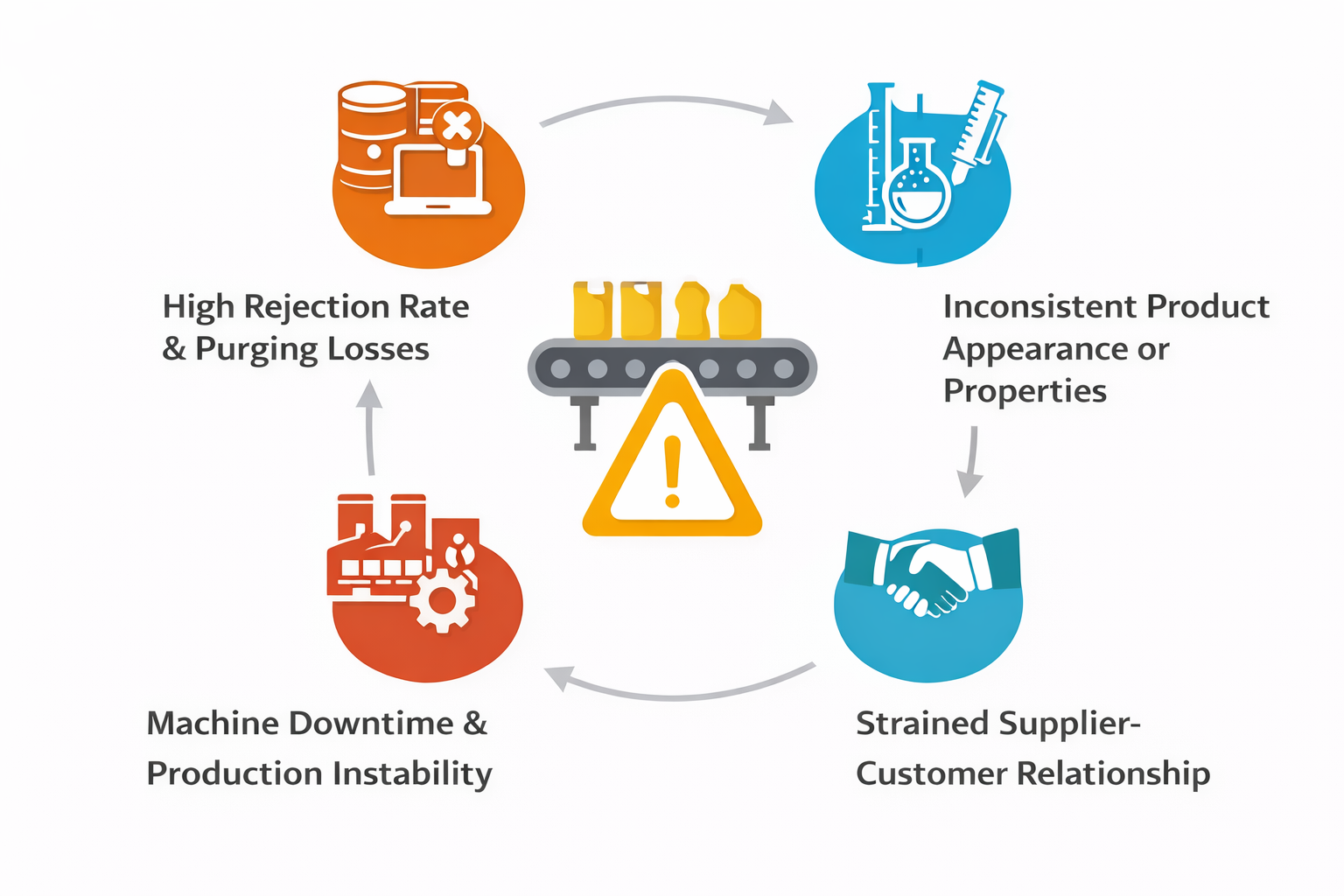
A single batch of defective masterbatch can lead to:
High rejection rates at the processor’s end
Machine downtime and purging losses
Inconsistent product appearance or properties
Strained supplier–customer relationships
From an industry standpoint, “masterbatch quality issues” and “masterbatch complaints” are rising concerns as processors demand higher precision, lower tolerance variation, and application-specific performance.
Common Quality Complaints in Masterbatch
1. Color Variation and Shade Inconsistency
Complaint:
Finished plastic parts show shade mismatch, streaks, or patchiness.
Root Causes:
Poor pigment dispersion due to inadequate shear during compounding
Incorrect pigment-to-carrier compatibility
Batch-to-batch variation in pigment strength
Inconsistent let-down ratios at customer end
Technical Insight:
Even minor variations in pigment particle size distribution can cause visible ΔE shifts in sensitive applications like packaging films, molded containers, or automotive parts.
2. Poor Dispersion and Speck Formation
Complaint:
Black spots, white specks, or unmelted particles in finished products.
Root Causes:
Inadequate melt mixing in twin-screw extruders
Overloaded screw configuration for high pigment loading
Agglomerated fillers or additives
Improper cooling and pellet cutting
Technical Insight:
Specks not only affect aesthetics but also act as stress concentrators, reducing mechanical strength.
3. Low Mechanical Performance of End Product
Complaint:
Reduced tensile strength, elongation, or impact resistance.
Root Causes:
Excessive filler loading to reduce cost
Incompatible carrier resin
Thermal degradation during masterbatch processing
Poor additive dispersion affecting polymer matrix integrity
Key Point for Buyers:
A cheaper masterbatch often results in hidden costs due to downgraded physical properties of the final plastic product.
4. Processing Issues: Die Build-Up, Screw Slippage, Smoke
Complaint:
Poor machine runnability at customer processing lines.
Root Causes:
Incorrect selection of processing aids
Low thermal stability polymer
Contamination or moisture presence
Carrier resin mismatch with base polymer
Technical Insight:
processing problems caused by masterbatch
5. Moisture-Related Defects
Complaint:
Bubbles, silver streaks, surface defects.
Root Causes:
Hygroscopic fillers not dried properly
Poor packaging and storage conditions
Inadequate moisture control during production
6. Inconsistent Pellet Size or Pellet Breakage
Complaint:
Feeding problems and uneven dosing.
Root Causes:
Improper strand cutting
Uneven cooling
Poor pelletizer maintenance
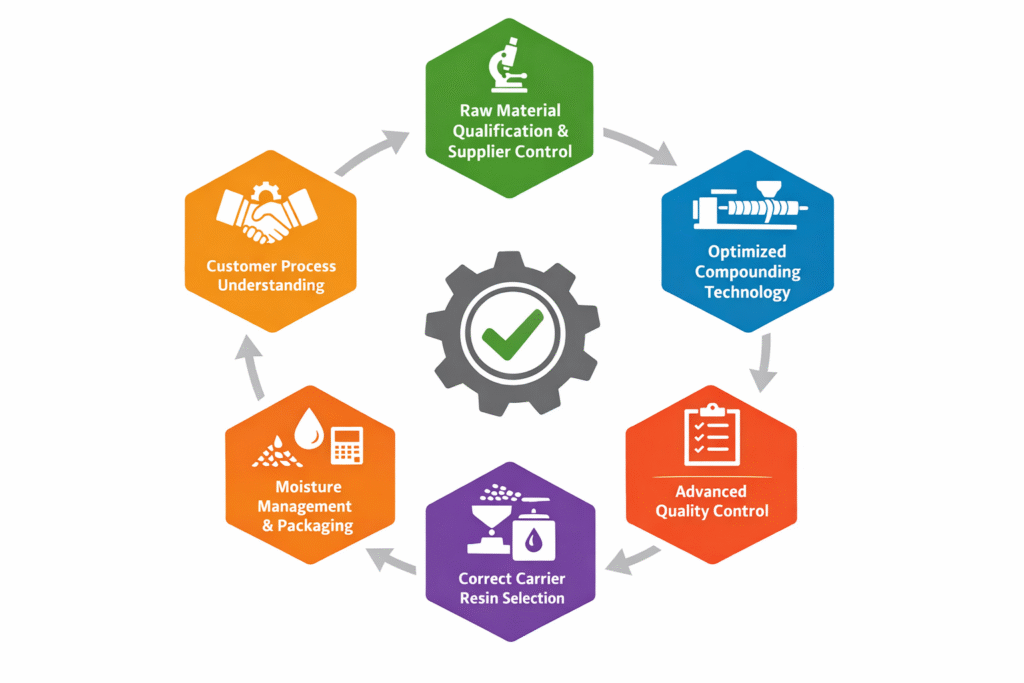
Root Cause Analysis (RCA): A Structured Approach
Leading masterbatch manufacturers follow a data-driven RCA framework, including:
Incoming raw material validation
In-process monitoring (torque, melt pressure, temperature)
Batch traceability and retention samples
End-use simulation testing
For buyers, suppliers who document RCA reports demonstrate maturity and reliability.
Root Cause Analysis (RCA): A Structured Approach
1. Raw Material Qualification & Supplier Control
Use consistent-grade pigments and additives
Conduct incoming QC: particle size, moisture, bulk density
Avoid frequent raw material substitutions without validation
2. Optimized Compounding Technology
Application-specific screw design
Controlled shear to balance dispersion without degradation
Gravimetric dosing for accuracy
3. Advanced Quality Control Systems
Spectrophotometer-based color control
MFI, ash content, dispersion testing
Retention samples for traceability
Tip for Buyers: Ask for COA + batch-wise QC data.
4. Correct Carrier Resin Selection
Carrier resin must match:
Base polymer (PP, PE etc.)
Processing temperature window
End-use regulatory requirements
Mismatch is one of the most underestimated causes of complaints.
5. Moisture Management & Packaging
Use dehumidified dryers
Moisture barrier packaging
Clear storage and shelf-life guidelines
6. Customer Process Understanding
Top-tier suppliers:
Study customer processing conditions
Recommend optimal let-down ratios
Offer trial support and troubleshooting
This transforms suppliers from vendors into technical partners.
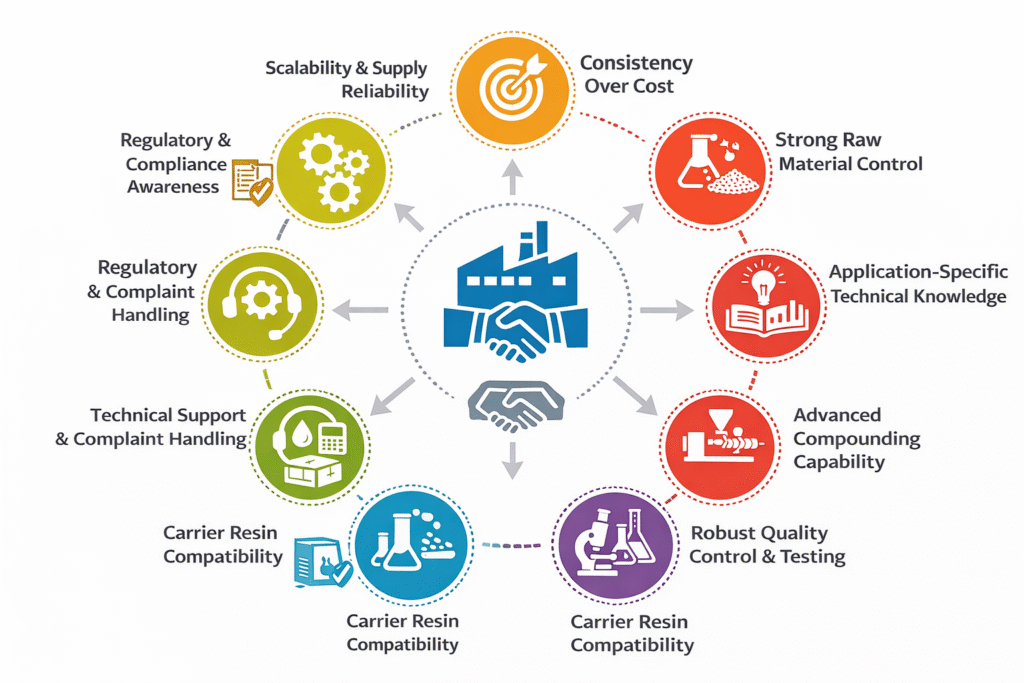
What B2B Buyers Should Look for in a Masterbatch Supplier
Before finalizing a supplier, evaluate:
Process capability, not just pricing
Consistency across multiple batches
Technical support responsiveness
Customization capability for applications
Remember: A reliable masterbatch supplier reduces your production risk.
Final Thoughts
Quality complaints in masterbatch are rarely random—they are the result of systemic gaps in raw material control, process design, or application understanding.
For B2B buyers and decision-makers, selecting the right masterbatch partner is a strategic decision, not a procurement formality.
By focusing on root cause analysis and preventive systems, both manufacturers and buyers can achieve:
Lower rejection rates
Stable production
Superior end-product performance
About Bajaj Plast Pvt. Ltd.
Bajaj Plast Pvt. Ltd. is a leading manufacturer of high-quality masterbatch solutions, dedicated to innovation, sustainability, and excellence. With a strong focus on customer satisfaction and cutting-edge technology, we are committed to delivering superior products that meet the evolving needs of the polymer industry.
