
Colour Matching Process in Masterbatch Manufacturing: How Shade Consistency is Achieved
In the plastic manufacturing industry, colour consistency is critical for product quality, branding, and market acceptance. Masterbatch manufacturers play a vital role in ensuring precise and repeatable colour shades across production batches.
But how exactly is shade consistency achieved in colour masterbatch manufacturing?
Let’s explore the complete colour matching process used by professional masterbatch manufacturers.
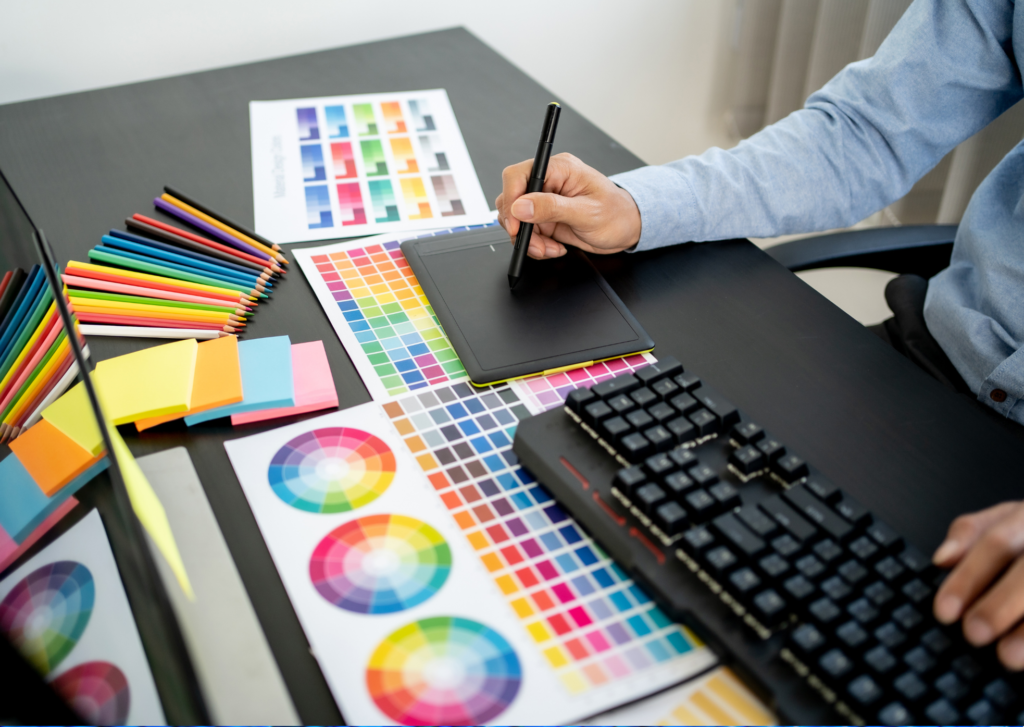
What is Colour Matching in Masterbatch?
Colour matching is the process of developing a masterbatch that reproduces an exact shade reference - such as Pantone, RAL, or a physical plastic sample - with minimal variation.
Industries that rely heavily on accurate colour masterbatch include:
Packaging industry
Automotive plastics
Household products
Agricultural films
Water tanks & containers
FMCG & branded products
Even minor colour deviation can result in rejection or brand inconsistency.
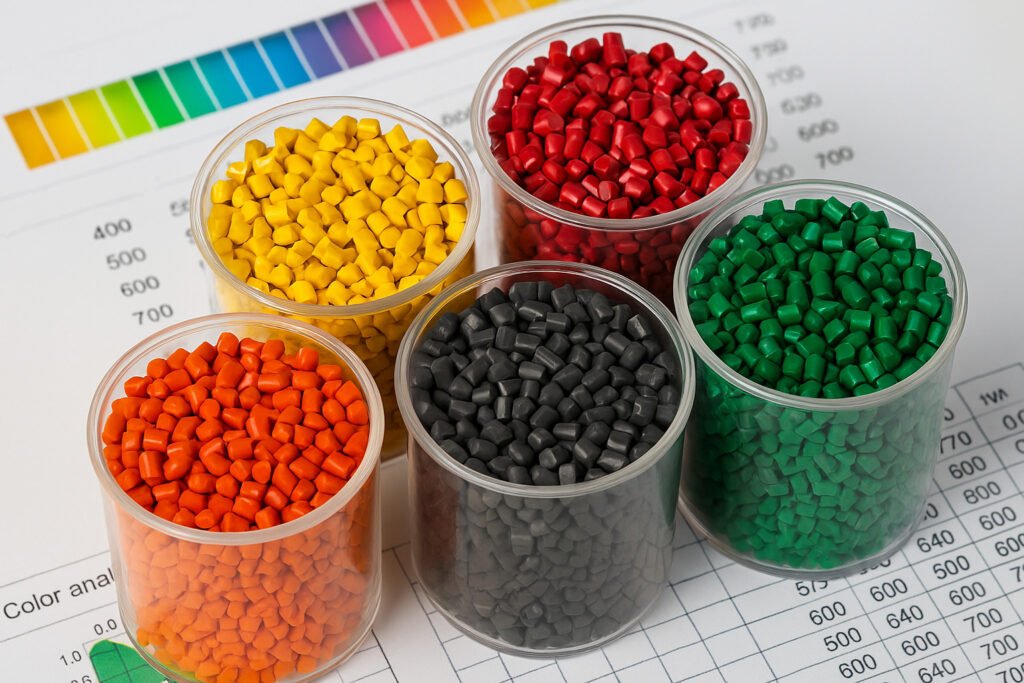
Step-by-Step Colour Matching Process
1. Shade Analysis Using Spectrophotometer
Advanced masterbatch manufacturers use spectrophotometers to measure colour values scientifically:
L* (lightness)
a* (red/green axis)
b* (yellow/blue axis)
The system calculates Delta E (ΔE), which determines colour difference from the reference sample.
Lower Delta E = Higher shade accuracy.
This ensures precise colour development rather than visual approximation.
2. Pigment Selection for Polymer Compatibility
Pigment selection depends on:
Polymer type (PP, PE, HDPE, ABS, etc.)
Heat stability
UV resistance
Light fastness
Migration resistance
Food-grade compliance (if required)
High-quality pigments ensure long-term colour stability and prevent fading, bleeding, or blooming.
3. Lab Trial & Sample Development
The selected formulation is processed in:
Twin-screw lab extruder
Injection moulding trial machine
Film extrusion trial line
Samples are evaluated under standardized D65 lighting conditions to confirm shade accuracy.
4. Controlled Production & Dispersion
Proper dispersion is critical for shade consistency.
Professional colour masterbatch manufacturers use:
High-shear twin-screw compounding lines
Optimized temperature profiles
Controlled screw configurations
This ensures uniform pigment distribution and eliminates streaking or shade patches.
5. Batch-to-Batch Quality Control
To maintain consistent colour masterbatch quality, manufacturers implement:
Spectrophotometer batch comparison
Standard retained samples
Raw material consistency checks
Strict QC documentation
This guarantees repeatable shade consistency across bulk production.

Factors Affecting Shade Consistency
Even with premium colour masterbatch, variation may occur due to:
Processing temperature differences
Polymer natural shade variation
Incorrect masterbatch loading percentage
Recycled material blending
Thickness variation in final product
Technical support from experienced masterbatch manufacturers helps minimize these risks.
Why Choose an Experienced Colour Masterbatch Manufacturer?
A technically strong masterbatch supplier ensures:
Accurate colour matching
Fast sample approval
Consistent batch quality
Reduced rejection rate
Long-term shade stability
Precision colour matching is not just production — it is a combination of science, formulation expertise, and process control.
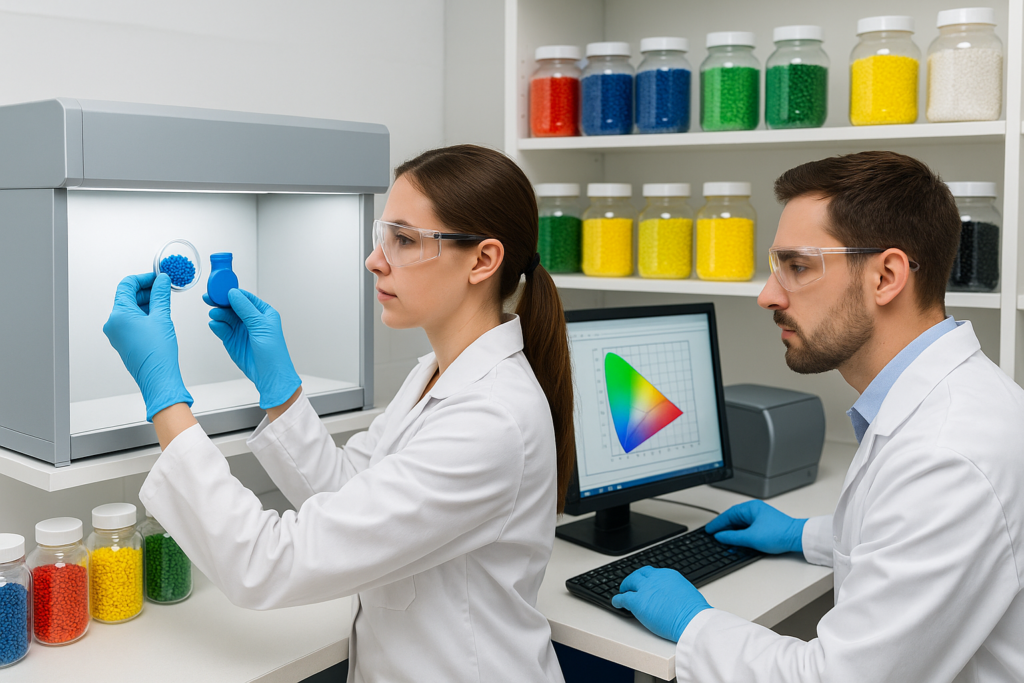
TECHNICAL R&D
1. Instrumental Colour Measurement & Data Acquisition
The process begins with spectrophotometric analysis using reflectance data across the visible spectrum (400–700 nm).
Key parameters measured:
CIELAB values (L*, a*, b*)
Chroma (C*)
Hue angle (h°)
Delta E (ΔE 2000 preferred)
Professional R&D labs target extremely low ΔE tolerance limits depending on application requirements (e.g., automotive vs. packaging).
2. Substrate-Specific Formulation Engineering
Colour perception is influenced by:
Polymer crystallinity (PP vs HDPE )
Melt flow index (MFI)
Natural resin yellowness index
Opacity and wall thickness
Additive interaction
Pigment concentration and dispersion characteristics are adjusted according to polymer rheology and end-use processing method.
This avoids metamerism and tone variation under different light sources.
3. Pigment Chemistry & Stability Selection
Pigment selection is based on:
Thermal stability at processing temperatures (180°C–300°C depending on polymer)
Light fastness ratings (Blue Wool Scale)
Weather resistance (for outdoor applications)
Heavy metal compliance (RoHS, REACH)
Food-contact compliance (FDA, EU)
Organic pigments provide brightness and tinting strength, while inorganic pigments offer opacity and heat resistance.
Balancing both ensures optical accuracy and long-term durability.
4. Dispersion Engineering & Compounding Control
Pigment dispersion is critical to colour uniformity.
Advanced manufacturers use:
Co-rotating twin-screw extruders
Controlled shear profiles
Optimized L/D ratios
Vacuum degassing systems
Poor dispersion leads to:
Speck formation
Shade streaking
Gloss inconsistency
Surface defects
Uniform dispersion ensures consistent optical performance in final products.
5. Batch Reproducibility & Statistical Quality Control
Consistency is maintained using:
Master standard retention samples
Statistical Process Control (SPC)
Spectral curve comparison
Controlled pigment lot traceability
Batch approval is based on defined ΔE acceptance criteria.
This ensures repeatability across thousands of kilograms of production.
6. Application-Specific Validation
Final validation includes:
Injection moulded plaques
Blow moulded samples
Film thickness variation testing
Accelerated UV exposure tests
Heat aging studies
This confirms long-term shade retention under real-world conditions.
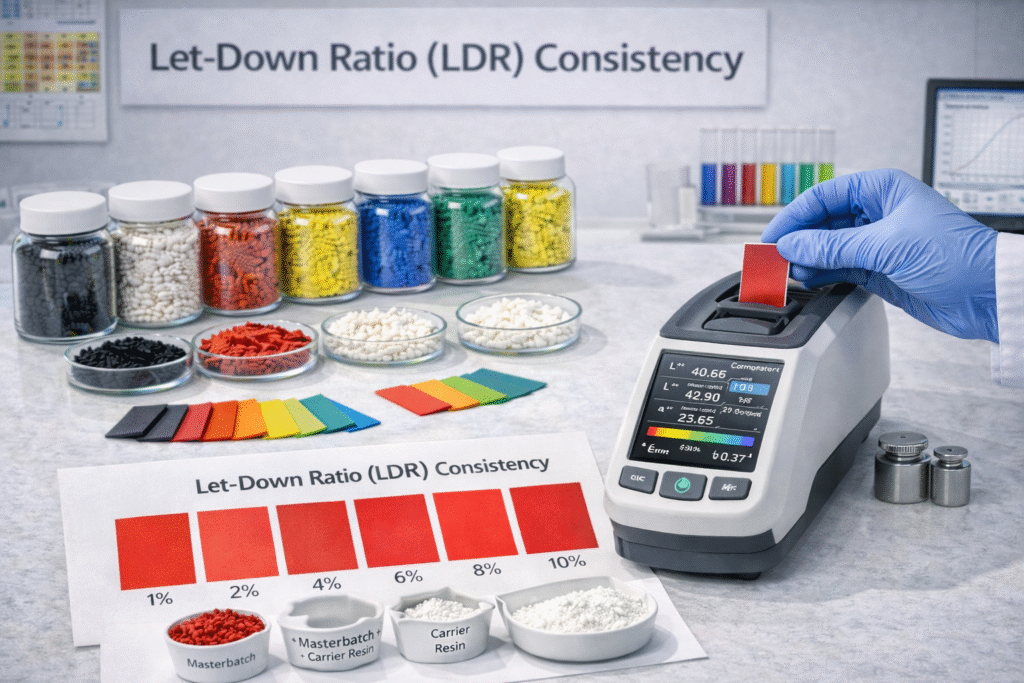
Conclusion
Advanced colour matching in masterbatch manufacturing is a multidisciplinary process combining:
Spectral analysis
Polymer science
Pigment chemistry
Process engineering
Quality control systems
Only manufacturers with strong R&D infrastructure, modern compounding technology, and technical expertise can consistently deliver precise shade replication across batches and applications.
Colour consistency is not accidental — it is engineered.
About Bajaj Plast Pvt. Ltd.
Bajaj Plast Pvt. Ltd. is a leading manufacturer of high-quality masterbatch solutions, dedicated to innovation, sustainability, and excellence. With a strong focus on customer satisfaction and cutting-edge technology, we are committed to delivering superior products that meet the evolving needs of the polymer industry.
