
Woven vs Non-Woven Geotextile Fabric: A Technical Perspective from Bajaj Masterbatches
Introduction
Geotextiles are permeable, polymer-based textiles engineered for use in geotechnical and civil engineering systems, where they perform separation, filtration, drainage, reinforcement, and containment functions within soil structures. As a masterbatch manufacturer supplying colour and functional additive concentrates to converters producing woven and non-woven polypropylene (PP) fabrics, Bajaj Masterbatches works closely with the polymer-processing decisions that determine how a geotextile performs in the field. This article examines the structural, mechanical, and additive-related distinctions between woven and non-woven geotextiles from a materials-engineering standpoint.

Structural Classification: Woven vs Non-Woven Construction
The fundamental distinction between the two categories lies in fibre architecture rather than raw polymer chemistry alone.
Woven geotextiles
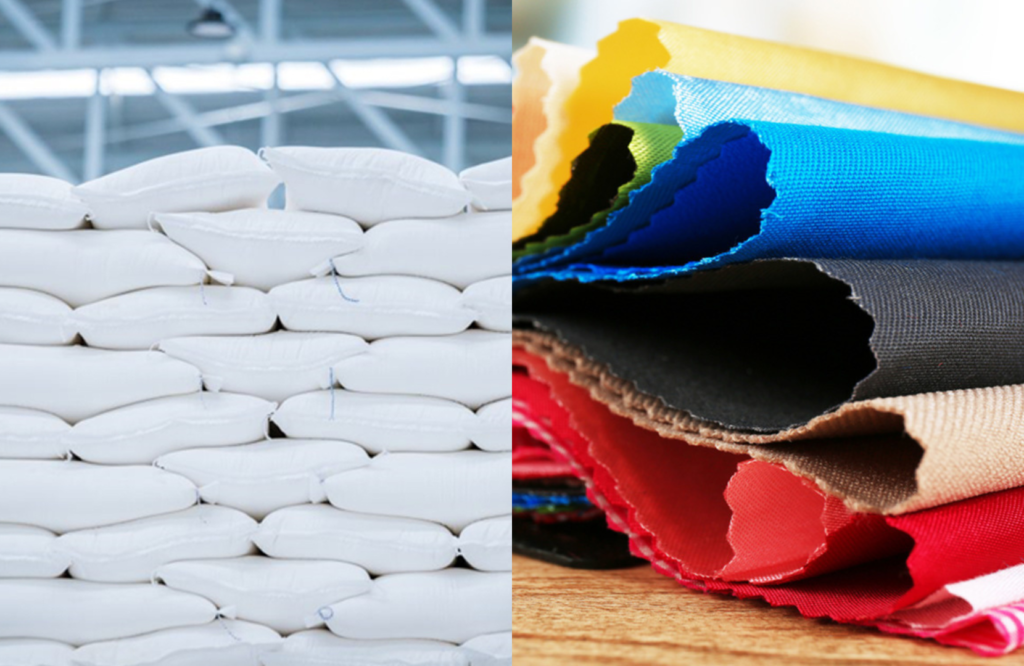
Woven geotextiles are produced by interlacing slit-film or monofilament PP yarns in an orthogonal warp-weft pattern on a loom, producing a grid-like, dimensionally stable structure. The interlaced geometry restricts elongation under load and gives the fabric a defined, engineered pore structure determined by yarn count and weave density.
Non-woven geotextiles
Non-woven geotextiles are formed by mechanically, thermally, or chemically bonding a randomly oriented fibre web, most commonly via needle-punching, spunbonding, or thermal calendering. The resulting structure has a statistically distributed, tortuous pore network rather than a fixed grid, which governs its filtration and permittivity characteristics.
Comparative Technical Properties
| Parameter | Woven Geotextile | Non-Woven Geotextile |
|---|---|---|
| Base polymer | Slit-film or monofilament PP/PET yarn | Staple or continuous-filament PP/PET fibre |
| Formation process | Loom weaving (warp-weft interlacing) | Needle-punching, spunbonding, thermal bonding |
| Tensile strength | High, low elongation at break | Moderate, higher elongation tolerance |
| Permittivity/AOS | Fixed, low permeability | Variable, high permittivity |
| Pore geometry | Regular, grid-defined | Random, tortuous path |
| UV/oxidative resistance | Governed primarily by stabilizer masterbatch loading in the yarn | Governed by stabilizer dispersion across a higher specific surface area |
| Puncture resistance (CBR) | Higher, due to interlaced load paths | Lower, but more conformable to substrate irregularities |
| Typical function | Reinforcement, separation, load distribution | Filtration, drainage, sediment control |
The Role of Masterbatch Formulation in Geotextile Performance
While fibre architecture defines the mechanical and hydraulic behaviour of a geotextile, long-term field performance is heavily influenced by the additive package compounded into the base resin before extrusion. This is where masterbatch formulation becomes a critical, though often underdiscussed, variable in geotextile engineering.
UV Stabilization
Both woven and non-woven PP geotextiles are susceptible to photo-oxidative degradation from UV exposure during storage, installation, and, in exposed applications, in service. PP is particularly vulnerable due to tertiary carbon sites in its backbone that are prone to radical-initiated chain scission. Bajaj Masterbatches formulates UV-stabilizer masterbatches using hindered amine light stabilizers (HALS) and UV absorbers dosed at concentrations typically in the range of 0.3–1.0% by weight, calibrated to the fabric’s expected service exposure duration. In woven fabrics, stabilizer efficacy is closely tied to yarn draw ratio and crystallinity, since stabilizer migration and surface bloom behave differently in highly oriented tape yarns versus the higher-surface-area fibres used in non-wovens.
Carbon Black and Colour Masterbatches
Carbon black masterbatches serve a dual function: they provide UV screening (through radical scavenging and light absorption) and enable colour coding for product identification across the woven/non-woven product range. Particle size distribution and dispersion quality of the carbon black are critical process parameters — poorly dispersed carbon black can act as a stress concentrator, reducing tensile and puncture performance, particularly relevant in high-strength woven reinforcement fabrics.
Antioxidant and Process Stabilization Packages
During melt extrusion, both slit-film tape production (for woven fabrics) and fibre spinning (for non-wovens) subject the polymer to high shear and thermal stress, which can initiate oxidative degradation and molecular weight loss. Primary (hindered phenolic) and secondary (phosphite-based) antioxidant systems are incorporated into masterbatch formulations to protect melt viscosity and preserve downstream mechanical properties, particularly important for maintaining consistent denier and tensile strength in continuous production runs.
Material Selection Criteria by Application
Reinforcement and load distribution (woven):
Applications such as road base reinforcement, embankment stabilization, and retaining wall backfill require low-elongation, high-tensile-modulus fabric. Woven PP tape yarns, compounded with UV and antioxidant masterbatches suited to extended outdoor exposure, are the appropriate specification.
Filtration and drainage (non-woven):
Subsurface drainage, French drains, and landfill filtration layers require controlled permittivity and AOS tuned to the surrounding soil gradation to prevent both piping (soil loss) and clogging. Needle-punched or spunbond non-woven fabrics, with fibre-level additive dispersion for consistent long-term permeability, are preferred.
Combined systems:
Many geotechnical designs specify composite systems — a woven layer for reinforcement paired with a non-woven layer for filtration — particularly in landfill cap systems and complex roadway subgrades where both structural and hydraulic performance are required simultaneously.
Degradation Indicators and Service-Life Considerations
Field-aged geotextiles typically show measurable declines in tensile strength and elongation-at-break as early indicators of polymer degradation, often preceding visible fraying or embrittlement. Since UV and thermo-oxidative stability are additive-dependent rather than purely polymer-dependent, the masterbatch specification used at the extrusion stage has a direct bearing on service life. Fabric converters should validate stabilizer package performance against relevant standards rather than relying on base polymer grade alone.
Conclusion
The woven-versus-non-woven distinction determines the mechanical and hydraulic role a geotextile can perform, but the additive and masterbatch formulation compounded into the resin determines how reliably that performance is sustained over the fabric’s service life. Bajaj Masterbatches works with geotextile fabric converters to formulate UV-stabilizer, carbon black, and antioxidant masterbatches matched to specific yarn and fibre processes — supporting consistent colour, dispersion, and long-term stability across both woven reinforcement fabrics and non-woven filtration fabrics.
For technical consultation on masterbatch formulation for geotextile and technical textile applications, contact the Bajaj Masterbatches technical team.
About Bajaj Plast Pvt. Ltd.
Bajaj Plast Pvt. Ltd. is a leading manufacturer of high-quality masterbatch solutions, dedicated to innovation, sustainability, and excellence. With a strong focus on customer satisfaction and cutting-edge technology, we are committed to delivering superior products that meet the evolving needs of the polymer industry.

 BAJAJ PLAST PVT LTD