
IR-Blocking and Light-Diffusion Masterbatch for Greenhouse Films: A Technical Procurement Guide
Introduction
Greenhouse film is a deceptively simple-looking product. To a grower it is just “the plastic on the roof.” To a formulator or a masterbatch purchase manager, it is a precision optical and thermal filter that has to manage two physically distinct parts of the electromagnetic spectrum at once , visible light coming in, and long-wave thermal radiation trying to get out , while surviving 12 to 48 months of UV exposure, agrochemical contact, and mechanical stress in the field.
The global greenhouse film market is currently valued in the range of USD 7.8–8.6 billion (2025–2026) and is projected to grow at a compound annual rate of roughly 8% through the early-to-mid 2030s, with Asia-Pacific accounting for the largest share of volume and LDPE remaining the dominant resin platform at roughly 46–47% share. Within that volume, functional masterbatches — IR-blocking, light-diffusion, UV-stabilization, anti-fog/anti-drip — are the primary value-add lever for film producers, and increasingly the deciding factor in which converter wins a season’s order from a commercial grower.
This article looks at the two technologies that do most of the agronomic heavy lifting: IR-blocking (thermal) masterbatch and light-diffusion masterbatch — their underlying physics, how they’re formulated, how they’re measured, and what a procurement or technical team should be asking suppliers before signing a contract.
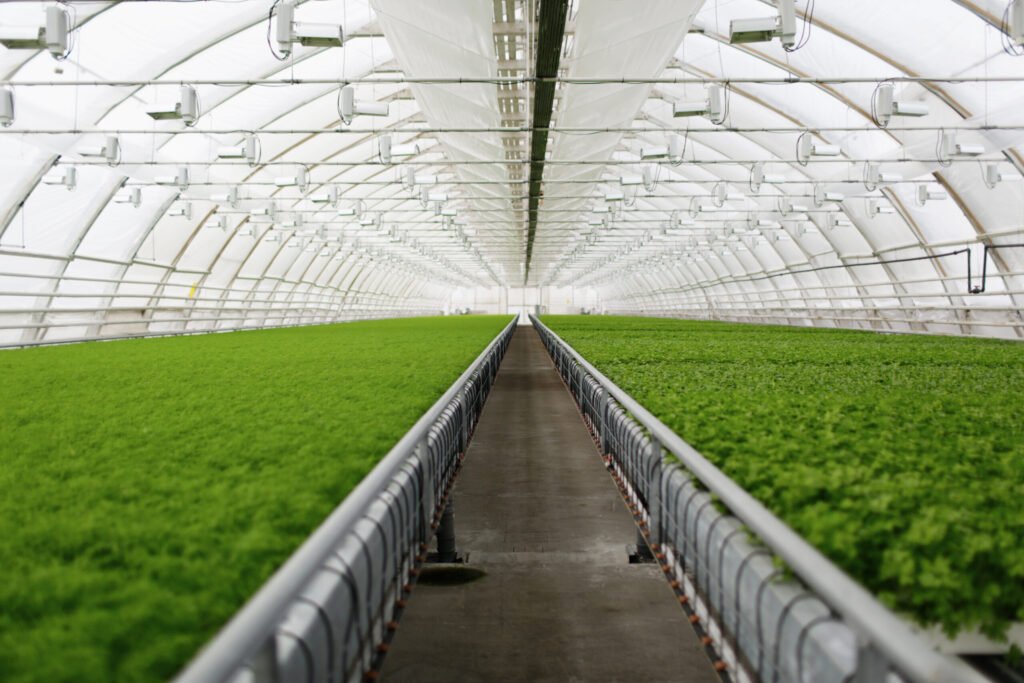
1. The Spectral Problem: Why Plain Polyethylene Film Falls Short
Solar radiation reaching a greenhouse spans roughly 290 nm (UV) through the visible range (380–720 nm, the photosynthetically active radiation or PAR band that drives photosynthesis) and on into the near-infrared (out to roughly 2,500–3,000 nm). A bare PE film is reasonably good at letting all of this through — which is exactly the problem at night.
After sunset, soil, plant tissue, and structural surfaces inside the greenhouse re-radiate the heat they absorbed during the day as long-wave (thermal) infrared radiation, concentrated in the 7–14 µm band. By Planck’s law, a surface at typical nighttime greenhouse temperatures (around 288 K / 15°C) radiates its peak energy density at approximately 10 µm — squarely inside this window. Standard low-density polyethylene is largely transparent in this exact range, so that thermal energy simply passes back out through the roof. This is the core reason unmodified PE greenhouses lose heat quickly on clear nights and are prone to chilling injury and condensation cycling.
Ethylene-vinyl acetate (EVA) copolymer films perform somewhat better on their own, because the carbonyl (C=O) and ester groups introduced by the vinyl acetate comonomer have their own absorption bands that extend into the mid-IR. In side-by-side testing, this gives unmodified PE/EVA film a baseline thermal (IR) efficiency around 50%, versus roughly 24% for unmodified LDPE — a meaningful native advantage, but still well short of what’s needed for serious thermal management in a cold-climate or shoulder-season application.
This gap is what IR-blocking masterbatch is designed to close.
2. Light-Diffusion Masterbatch: Mechanism and Agronomic Value
3.1 Haze, clarity, and what they actually measure
Haze (%) = (Diffuse Transmittance / Total Transmittance) × 100
A second, less commonly specified but agronomically important parameter is clarity, which captures how tightly the scattered light cone spreads at small angles — two films can report identical haze values and still behave very differently under crop canopy, because clarity (and the related scattering-angle coefficient) determines how “soft” versus “milky” the diffusion actually looks and performs.
3.2 The physical mechanism: refractive index mismatch
Diffusion masterbatches work by dispersing fine particles whose refractive index differs from that of the host polyethylene (n ≈ 1.51–1.53). Common diffusing agent classes include:
- Precipitated or ground calcium carbonate (n ≈ 1.59)
- Synthetic amorphous silica (n ≈ 1.45–1.46)
- Barium sulfate (n ≈ 1.64)
- Talc (n ≈ 1.54–1.59)
- Engineered polymeric/acrylic microspheres, used in premium grades where minimizing PAR transmission loss matters more than raw cost
When particle size falls in the same general range as visible wavelengths (roughly 1–10 µm), the refractive index mismatch produces Mie-regime scattering — light bends around and through each particle rather than passing straight through, redistributing direct beam radiation into diffuse radiation without necessarily removing it from the usable PAR budget. This is the critical distinction from simple opacifying or whitening agents: a well-designed diffusion package scatters light rather than absorbing or blocking it.
As with IR additives, particle size drives the haze/clarity/gloss balance directly. In comparative blown-film testing, adding ~7.5% of a fine mineral diffusing filler to unfilled LDPE took diffuse light transmission from roughly 8% to 28–32%, and haze from roughly 10% to 36–43%, with the finer particle grades consistently producing the lower-haze, higher-clarity result and the coarser grades producing the strongest overall scattering.
3.3 The haze/PAR transmission trade-off — and why it's not optional
Every diffusion system trades some total light transmission for scatter. In one widely cited engineering reference range for greenhouse screening films, the practical “sweet spot” sits around haze 70–86% combined with clarity 18–35%; push haze too high or clarity too low and backscatter losses start removing light from the system entirely rather than just redistributing it.
What haze target is “correct” depends entirely on climate and crop:
- High-radiation, hot climates (intense, near-equatorial or high-altitude sun): haze above ~60% is generally preferred to reduce leaf scorch and canopy stress.
- Low-light, cold, or frequently overcast climates: haze below ~25% is generally preferred, since every percentage point of total transmission lost matters more than the diffusion benefit when ambient light is already the limiting factor.
3.4 Why growers actually pay for this
The agronomic case for diffusion is well documented in controlled trials. Research conducted at Wageningen University in the Netherlands found that diffuse greenhouse covering materials increased summer sweet pepper production by 5–6%, increased cucumber fruit count by 7.8% with a 4.3% weight increase, and produced tomatoes averaging roughly 8.5 grams heavier per fruit than equivalent crops under clear film; for potted chrysanthemum, the cultivation cycle was shortened by roughly 25%. The mechanism behind these gains is consistent across crops: diffuse light eliminates hard shadow lines, pushes usable PAR deeper into the lower canopy, reduces localized leaf-surface overheating and transpiration stress, and produces a more uniform internal greenhouse temperature profile — all of which translate into more total leaf area photosynthesizing efficiently across the day rather than a smaller area photosynthesizing at saturation while the rest sits in shadow.
4. Engineering Combination Films: Where the Two Technologies Meet
Most commercial greenhouse films today are not single-function products — they stack IR-blocking, diffusion, UV stabilization, and anti-fog/anti-drip into one structure, usually via three- or five-layer coextrusion rather than a mono-film. This is where formulation discipline (and supplier technical competence) really shows up, because each additive package competes for the same optical budget.
Representative PAR transmission benchmarks across film categories illustrate the cumulative cost of stacking functions:
| Film type | Typical PAR transmission |
|---|---|
| UV-stabilized clear film | 88–91% |
| IR-blocking / anti-condensation film | 82–87% |
| IR-blocking + diffusion combination film | 77–88% |
The wide range on the combination film reflects exactly how much formulation skill matters here — the difference between a mediocre and an excellent combination film is largely a function of particle size selection, dispersion quality, and layer placement, not the raw additive type. As a general rule of thumb used in extension and grower literature, each percentage point of PAR transmission gained or lost translates roughly to a percentage point of plant growth rate during light-limited periods of the season — which is precisely why purchase managers should treat PAR transmission spec sheets as a financial document, not just a technical one.
Practical formulation strategies worth specifying or asking suppliers about:
Applications Where Temperature Control Is Critical
Film and Packaging
Requires precise temperature control to ensure clarity, strength, and uniform thickness.
Pipes and Profiles
Incorrect temperatures can lead to internal defects and reduced durability.
Injection Molding
Temperature affects flow behavior and final product consistency.
Blow Molding
Impacts wall thickness and surface finish.
Across these applications, temperature control is directly linked to performance and efficiency.
Why Temperature Consistency Matters More Than Just Settings
In extrusion, it’s not only about reaching the right processing temperature, but it’s also about maintaining consistency throughout the process. Even when the average temperature is correct, fluctuations across zones can lead to uneven melting and poor masterbatch performance. Small temperature variations can result in:
- Inconsistent dispersion of additives
- Variations in color or surface finish
- Unstable flow during extrusion
Maintaining stable temperature conditions ensures uniform mixing, better product quality, and fewer production issues over time.
Best Practices for Managing Processing Temperature
Follow the Recommended Temperature Range
Each polymer and masterbatch has an ideal processing window.
Monitor Temperature Zones
Ensure uniform heating across all zones of the extruder.
Avoid Overheating
Excess temperature can degrade additives and polymer.
Maintain Stable Processing Conditions
Consistent temperature leads to consistent results.
Across these applications, temperature control is directly linked to performance and efficiency.
Bottom Line for Purchasing Decisions
IR-blocking and light-diffusion masterbatch are not interchangeable commodity additives — they solve two different physics problems (long-wave thermal retention versus visible-light scattering), they’re measured against two different standards (DIN EN 13206 versus ASTM D1003), and they compete for the same finite optical budget when combined in one film. The suppliers worth building a long-term contract with are the ones who can hand over particle-size data, IR-efficiency curves, haze/clarity trade-off data, and documented compatibility with your specific anti-fog and UV packages — not just a haze percentage on a one-page spec sheet.
For a purchase manager, the right question isn’t “what’s your IR-blocking masterbatch’s price per kilo.” It’s “show me the IR efficiency curve, the PAR transmission at your recommended let-down ratio, and your compatibility data with our anti-fog system” — because in greenhouse film, the additive that looks cheapest on the invoice is frequently the one that costs the grower the most in lost yield over a season.
About Bajaj Plast Pvt. Ltd.
Bajaj Plast Pvt. Ltd. is a leading manufacturer of high-quality masterbatch solutions, dedicated to innovation, sustainability, and excellence. With a strong focus on customer satisfaction and cutting-edge technology, we are committed to delivering superior products that meet the evolving needs of the polymer industry.

