
Bajaj Masterbatch · Engineered Polymer Solutions
Antistatic Masterbatch
for FIBC Bulk Bags
Precision-engineered electrostatic discharge control for polypropylene woven bulk containers.Compliant formulations that protect cargo, people, and infrastructure.
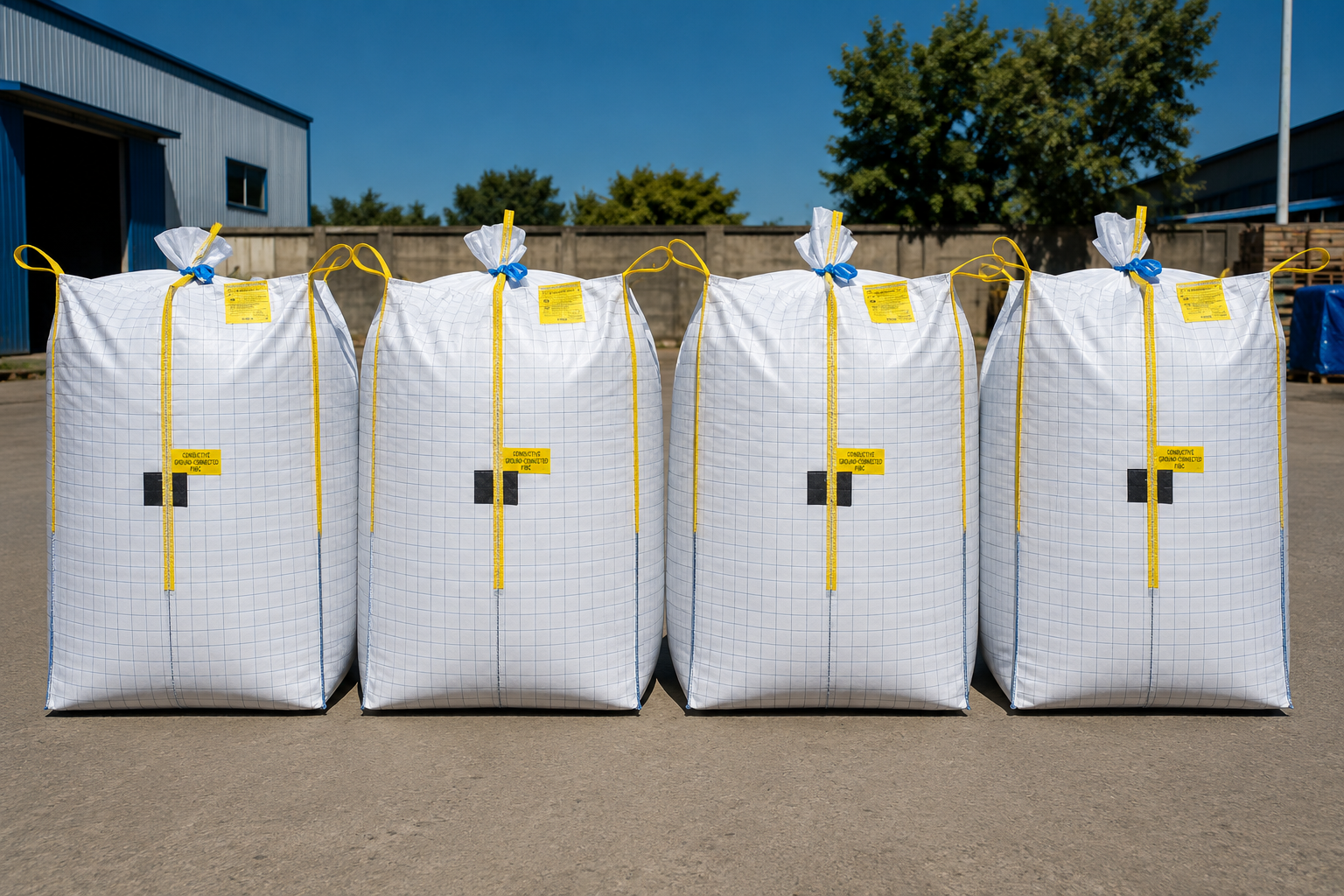
Type C & D Control
Maintained Post-Treatment
Retention Rate
Formulation Expertise
The Science of Static Hazard
Why Antistatic Masterbatch is Critical for FIBC Bulk Bags
Polypropylene, the primary substrate of FIBC woven fabric, is an inherently insulative dielectric polymer with a surface resistivity exceeding 1014 Ω/sq — creating conditions for triboelectric charge accumulation during filling, discharging, and transport operations that can reach ignition-threshold potentials exceeding 1000V.
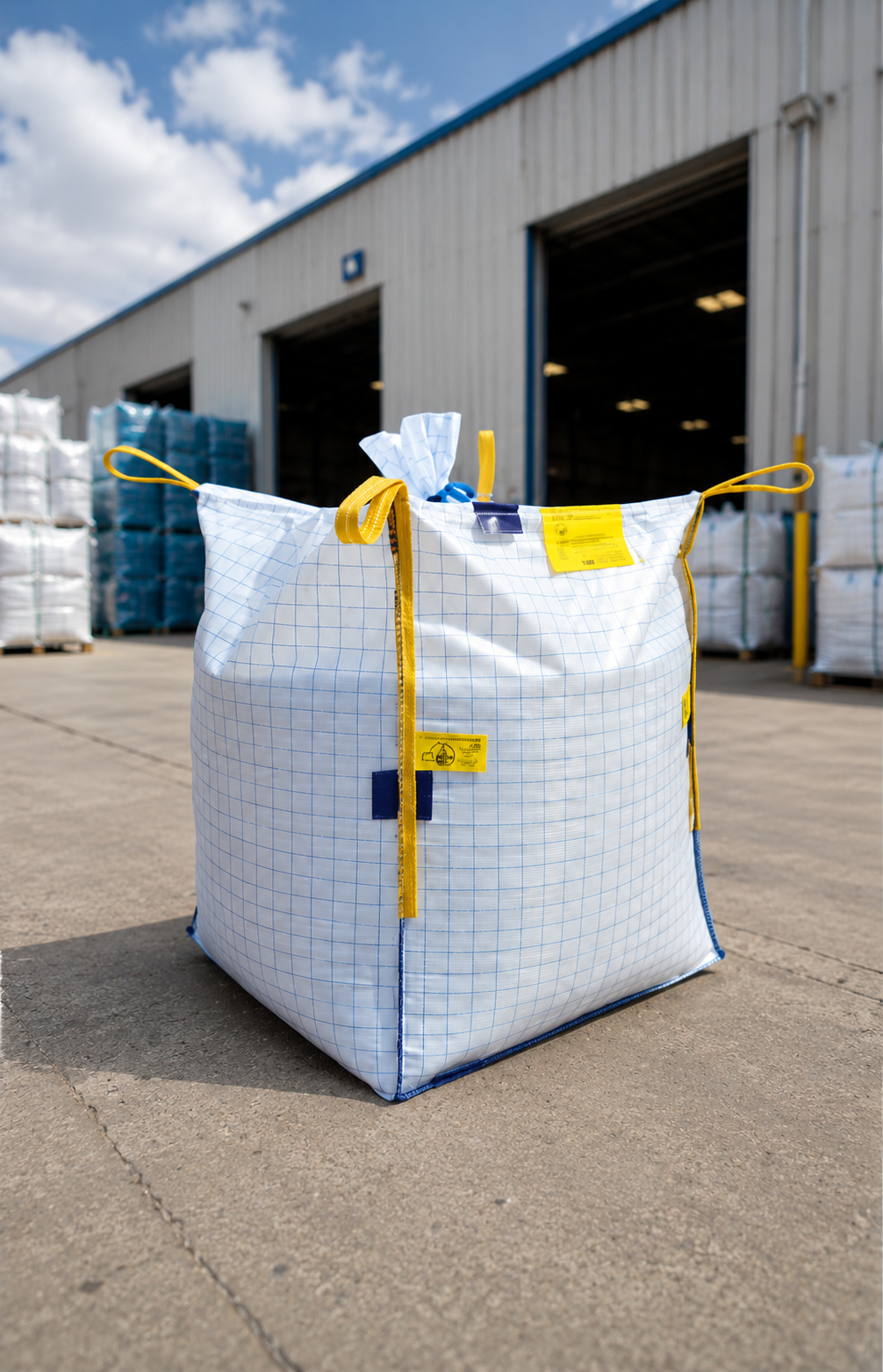
Triboelectric Charge Generation
During pneumatic filling of fine powders (D50 <150μm), particle-to-fabric contact generates electrostatic charge via triboelectric effect. Charge densities of 10–100 μC/kg are routinely measured in unprotected PP-woven FIBC systems, creating ignitable electrostatic discharge events.
Minimum Ignition Energy (MIE) Risk
Bulk solids classified as Dust Explosion Group St-1 to St-3 have MIE values as low as 1–10 mJ. Propagating brush discharges from insulative FIBC surfaces routinely release energies of 5–25 mJ — well within or exceeding the ignition threshold for most organic powders and flammable solvents.
Powder Cling & Process Contamination
Surface charge densities above 1011 Ω/sq cause fine particulates (<50μm) to electrostatically adhere to inner liner surfaces, reducing discharge efficiency by 15–30% and creating cross-contamination risks in GMP-regulated pharmaceutical and food-grade operations.
Four Critical Stress Vectors
Core Electrostatic Failure Modes in FIBC Systems
Propagating Brush Discharge
Occurs on insulative surfaces with high charge density (>2.7 μC/m²). Energy release of 1–3 mJ — sufficient to ignite solvent vapours and fine dust clouds classified as IEC 60079-10-2 zones.
Cone Discharge
Cone-shaped electrostatic discharge occurring in the powder bulk itself during filling. Releases up to 10–100 mJ energy, capable of igniting St-1 and St-2 dust groups with MIE thresholds >3 mJ.
Spark Discharge
Capacitive discharge between FIBC and an earthed conductor. Charge accumulation on isolated FIBC structures can produce sparks with energies exceeding 100 mJ — a critical hazard in Zone 1/2 classified areas.
FIBC Classification Matrix
Which Types of Bulk Bags Require Antistatic Masterbatch?
IEC 61340-4-4 defines four standardised FIBC types based on electrostatic protective properties. Types B, C, and D all incorporate some level of antistatic engineering — with masterbatch formulation playing the primary role in Type B and forming the conductive matrix in Type C and D constructions.
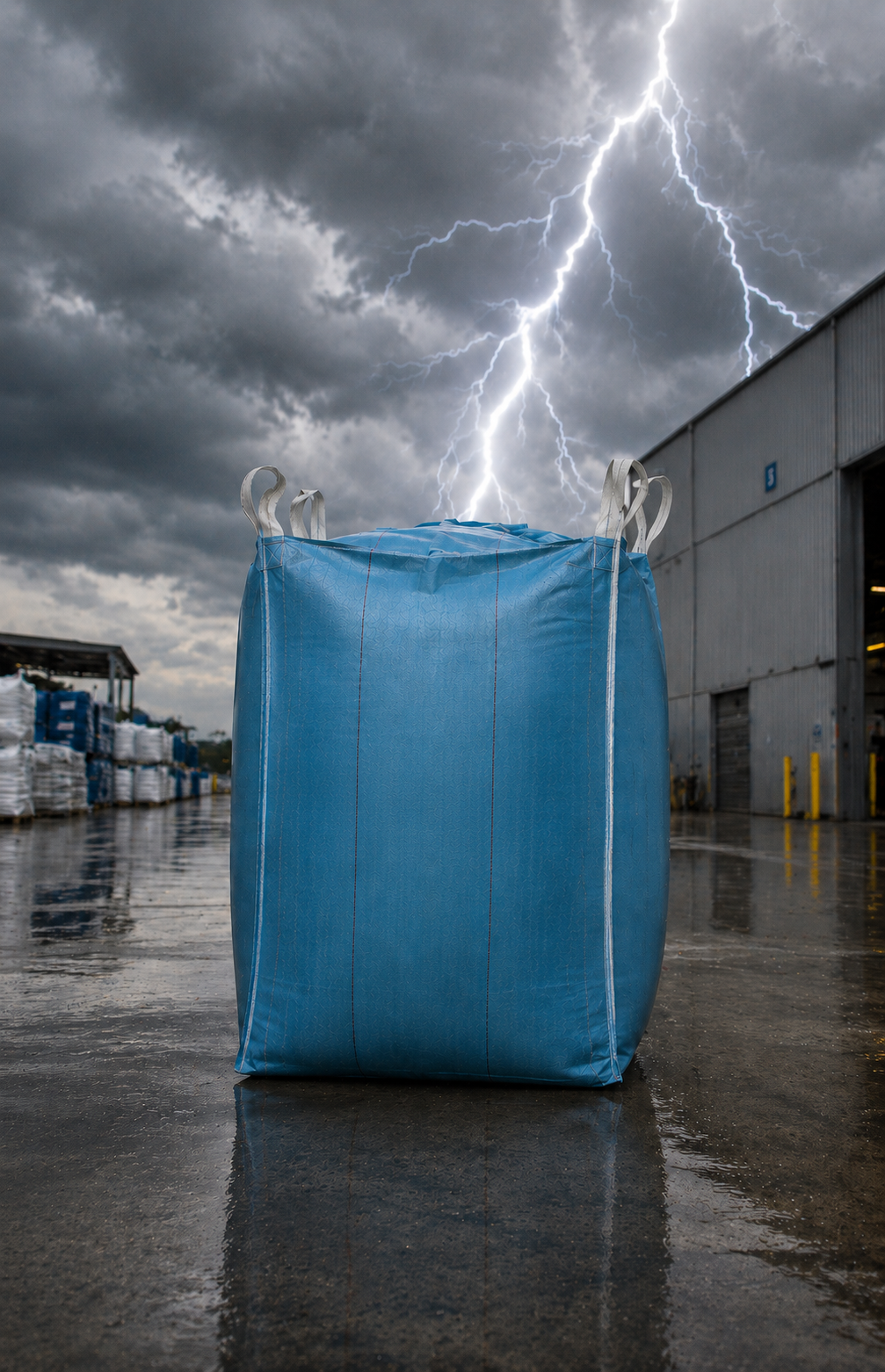
Standard PP FIBC — No Antistatic Protection
Unmodified polypropylene construction. Surface resistivity >1014 Ω/sq. For non-flammable, non-combustible bulk solids only. No antistatic masterbatch required.
Low Breakdown Voltage — Antistatic PP Masterbatch
Antistatic masterbatch reduces surface resistivity to prevent propagating brush discharge. Breakdown voltage <6 kV. Suitable for flammable solvents with MIE >3 mJ. Bajaj Migratory Grade recommended.
Groundable Conductive FIBC — Carbon-Black Masterbatch
Conductive threads in woven pattern form a Faraday cage topology. Carbon-black or conductive masterbatch achieves surface resistivity <107 Ω/sq. Mandatory earthing during all operations.
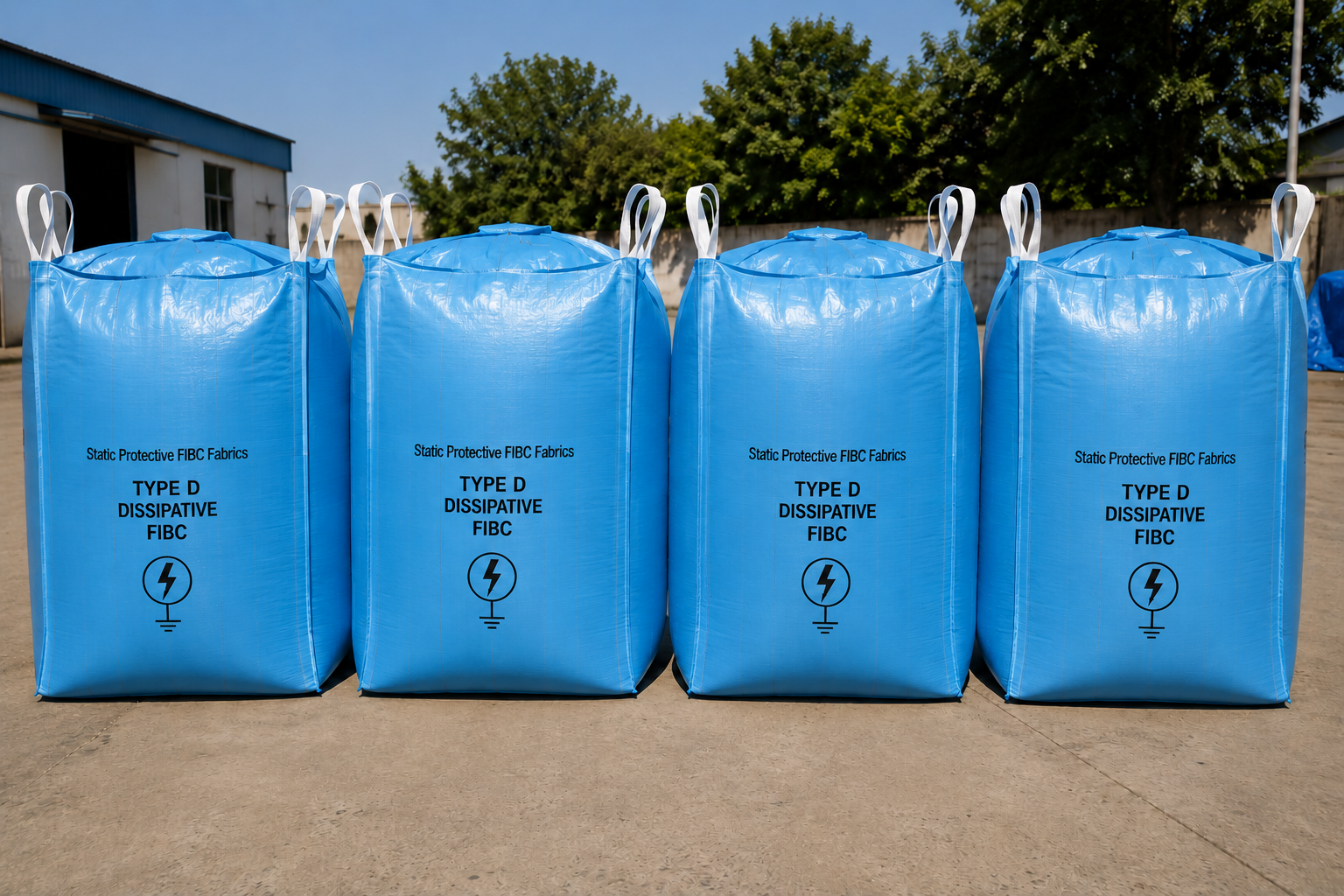
Dissipative FIBC — Permanent Anti-Static Masterbatch
Uses quasi-conductive threads with controlled dissipation without grounding requirement. Surface resistivity 108–1011 Ω/sq. Bajaj permanent antistatic masterbatch integrated into PP extrusion process for consistent cross-section conductivity.
Manufacturing Process
How Antistatic FIBC Bulk Bags Are Made
Bajaj Antistatic Masterbatch is introduced at the tape extrusion stage — the foundational step of the PP woven fabric manufacturing process — ensuring uniform electrostatic dissipation across the full cross-section of every monofilament tape.
PP Compounding & Masterbatch Dosing
Bajaj Antistatic Masterbatch is dry-blended with PP homopolymer resin at 1.5–3.0% let-down ratio. The carrier system (PP or LLDPE-based) ensures homogeneous dispersion in the extruder barrel.
Tape Extrusion & Orientation
Molten PP compound is extruded through a flat-die slot, quenched in a water bath, slit into tapes of 1.5–4.0 mm width, and uniaxially oriented at 5–8× draw ratio to develop tensile strength of 300–450 MPa.
Circular Loom Weaving
Oriented tapes are interlaced on circular rapier looms (typically 4–12 shuttles) to produce tubular woven fabric with controlled weave density (12–16 tapes/inch) ensuring dimensional stability under rated SWL.
Lamination, Printing & Conversion
Fabric undergoes BOPP lamination for moisture barrier performance, flexographic printing with food-safe inks, and is cut and sewn into finished FIBC configurations with integrated conductive ground straps for Type C variants.
Engineering Static-Free
Supply Chain Performance
Bajaj Masterbatch formulations are developed in-house and providing comprehensive electrostatic safety across global regulatory frameworks.
Performance Parameters
Key Features of FIBC Bags
Using Bajaj Antistatic Masterbatch
Controlled Surface Resistivity
Precision-formulated antistatic agents deliver surface resistivity consistently in the 10⁸–10¹¹ Ω/sq range — the optimal dissipative window for Type D FIBC construction, preventing both excessive charge accumulation and over-conduction risk.
Thermal Stability up to 220°C
Antistatic active agents remain chemically intact throughout the tape extrusion thermal profile (200–220°C melt temperature), ensuring no degradation-induced colour shift or loss of electrostatic performance.
Chemical Inertness
Bajaj formulations are pH-neutral and non-reactive with stored materials including agricultural chemicals, pharmaceutical APIs, and food-grade powders.
Humidity-Independent Performance
Unlike surface-applied antistatic coatings, masterbatch-incorporated antistatic agents provide consistent performance across relative humidity ranges of 10–90% RH.
No Migration Contamination
Permanent antistatic grades are covalently or polymeric-bound within the PP matrix — zero migration into bulk contents, critical for pharmaceutical GMP compliance.
Process Compatibility — No Line Modification
Bajaj masterbatch is engineered with MFI-matched carrier resin (MFI 3–6 g/10min at 230°C/2.16 kg) for seamless integration into existing tape extrusion lines without requiring screw, die, or temperature profile modifications. Typical let-down ratio 2–3% provides excellent dispersion index DI >0.85 per ASTM D3218.
Mechanical Property Retention
Critical manufacturing requirement: antistatic incorporation must not compromise tape tensile strength or elongation. Bajaj formulations are validated to maintain tensile strength within ±5% of unmodified PP control specimens — safe working load integrity is fully preserved at rated 5:1 safety factor per ISO 21898.
Value Engineering
Critical Benefits & Importance of Antistatic Masterbatch for FIBC Bags
Explosion & Fire Prevention in ATEX Zones
Antistatic masterbatch reduces surface resistivity below the propagating brush discharge threshold (<1011 Ω/sq), eliminating the primary ignition source in Zone 1/2 classified hazardous areas handling combustible dust concentrations exceeding the LEL.
Regulatory Compliance
Bajaj antistatic FIBC masterbatch enables compliance with Important complaince Certification — providing documented electrostatic safety evidence for facility risk assessments and insurance requirements.
Improved Powder Flow & Discharge Efficiency
Reduction of surface electrostatic charge eliminates powder cling on inner surfaces, improving volumetric discharge efficiency by 18–35% for cohesive fine powders (<100μm) — directly reducing unrecovered product losses in bulk pharmaceutical and chemical operations.
Worker Safety & ESD Shock Prevention
Dissipative FIBC surfaces prevent personnel shock from contact discharge events. Slow charge dissipation (time constant 10–100ms) through the 10⁸–1011 Ω/sq resistivity window ensures energy per discharge remains below the 350 mJ pain threshold per IEC TR 61340-1.
Sensitive Electronic Equipment Protection
In pharmaceutical, semiconductor, and electronics manufacturing environments, antistatic FIBC prevents electrostatic fields that can couple to and damage sensitive components. Critical for Class 100/ISO 5 cleanroom-adjacent bulk material operations.
Extended Service Life & Fatigue Resistance
Antistatic surface properties reduce particulate adhesion-induced abrasion on FIBC inner surfaces. Combined with UV stabilizer packages from Bajaj, FIBC bags demonstrate 40–60% extended service life in repetitive fill-discharge cycle testing (ISO 21898 Annex C protocol).
Technical Datasheet
Bajaj Antistatic Masterbatch
Technical Specifications
| Parameter | Migratory Grade | Permanent Grade | Conductive Grade |
|---|---|---|---|
| FIBC Type Applicability | Type A, B | Type B, D | Type C |
| Carrier Resin | PP Homopolymer | PP / LLDPE | PP Homopolymer |
| Let-Down Ratio (LDR) | 1.5–2.5% | 2.0–3.5% | 3.0–5.0% |
| Surface Resistivity Achieved | 10¹⁰–10¹² Ω/sq | 10⁸–10¹¹ Ω/sq | <10⁷ Ω/sq |
| Processing Temperature | 190–220°C | 195–225°C | 195–225°C |
| Humidity Sensitivity | Moderate (RH dependent) | None — permanent | None — carbon-based |
| Standard Compliance | ISO 21898 | ||
| Food Contact Compliance | - | FDA 21 CFR | Application specific |
| Tensile Strength Retention | ≥97% | ≥95% | ≥93% |
Why Choose Bajaj
Why Bajaj Antistatic Masterbatch
for FIBC Bulk Bags?
Bajaj Masterbatch brings three decades of polymer additive formulation science to antistatic FIBC applications — delivering engineered solutions that balance electrostatic performance with mechanical integrity, processability, and global regulatory compliance.
In-House R&D Formulation Laboratory
Dedicated compounding and characterisation facility with surface resistivity mapping, DSC thermal analysis, and tensile testing to IEC and ASTM standards — enabling rapid custom formulation turnaround.
Application-Specific Grade Engineering
Unlike commodity antistatic masterbatches, Bajaj develops FIBC-specific grades with MFI, dispersion index, and let-down ratio precisely matched to client extrusion equipment parameters and target FIBC type classification.
Batch-to-Batch Consistency — SPC Controlled
Statistical Process Control (SPC) monitoring of surface resistivity, MFI, and colour parameters across every production batch — Cpk ≥1.33 specification for critical electrostatic performance parameters.
Technical Application Support
On-site process optimisation assistance, FIBC bag testing support (IEC 61340-4-4 test protocol guidance), and compliance documentation for ATEX risk assessment submissions.
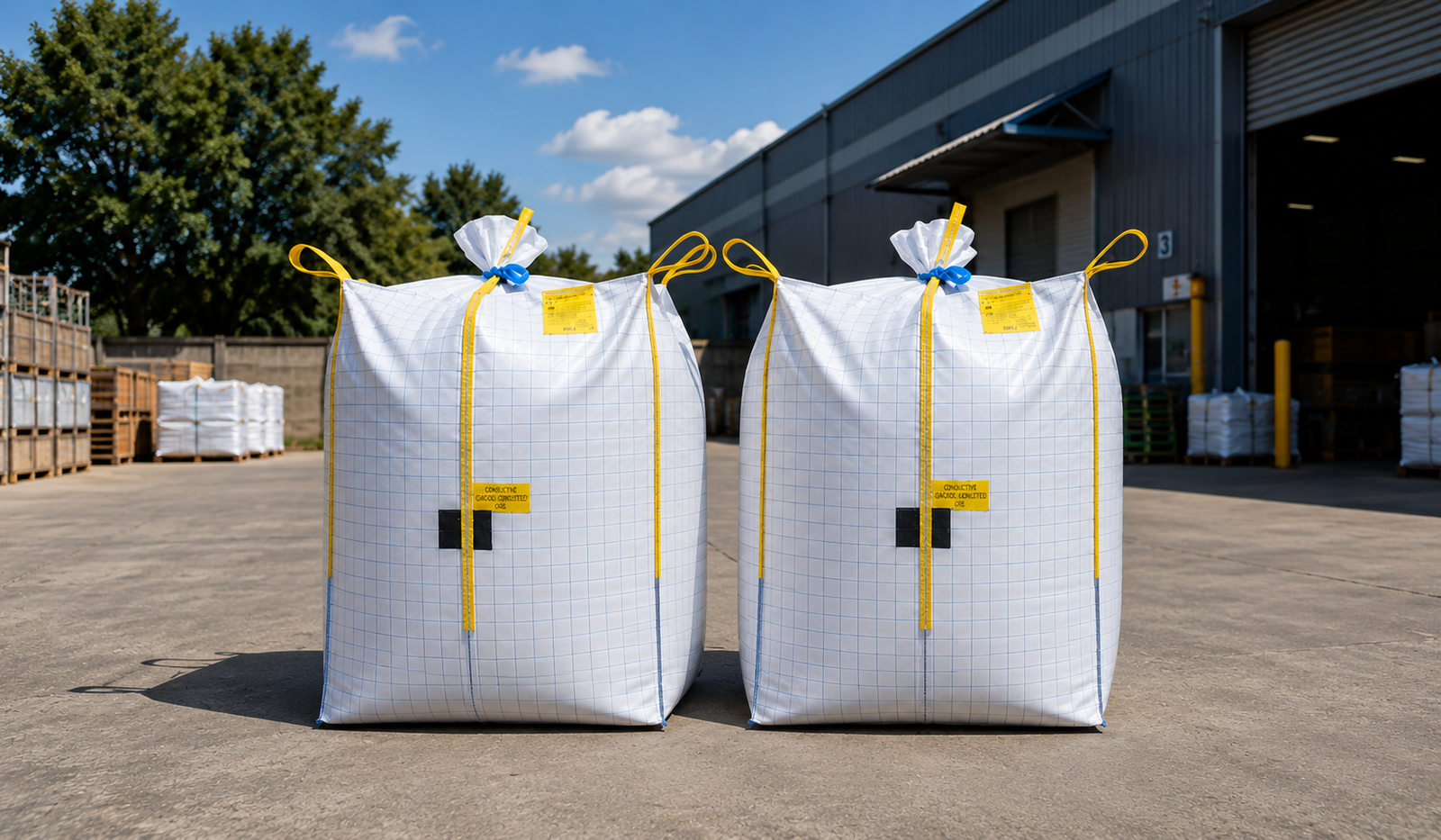
Industry Applications
Industries Requiring Antistatic FIBC Bulk Bags
Any industry handling fine powders, combustible particulates, or static-sensitive materials in bulk quantities must operate with IEC 61340-4-4 compliant FIBC bags incorporating certified antistatic protection.
Precision Electrostatic Control.
Engineered for FIBC Safety.
Consult with Bajaj Masterbatch technical specialists to determine the optimal antistatic grade and let-down ratio for your specific FIBC application, bulk material classification, and regulatory compliance requirements.
Connect with Our Experts → BAJAJ PLAST PVT LTD